Newsletter Subscribe
Enter your email address below and subscribe to our newsletter



This content may contain affiliate links. When you buy through these links, we may earn an affiliate commission.
There has never been a worse time to choose what to read next, only because there has never been more to choose from. Tens of thousands of novels appear each year, and no reader can sort them alone. This is the quiet usefulness of the literary prize: it is a century of juries, sitting in Stockholm and London and New York, doing a first pass of the sorting on our behalf, lifting a handful of books out of the flood each year and asking us to look.
The award-winning books gathered here are the ones that have best survived that scrutiny, drawn from the most prestigious literary awards in the world. A word of honesty before we begin: no prize is infallible, and half the pleasure of following them is disagreeing with the verdict. Treat the list not as an authority but as a set of doors, organized by the award that opened each one, with the full winner lists a click away. Different prizes reward different things, a lifetime or a single novel, a book in English or a book carried across from another language, and knowing which is which is the beginning of using them well.
A prize is a filter, not a verdict. It cannot tell you a book is great, because greatness is decided slowly, by time and by readers, long after the ceremony is forgotten. What a good award can do is narrow the field with more care than any algorithm, and record what serious readers valued in a given year. The trick is to know what each one is measuring. The Nobel crowns a whole career and belongs to no language; the Booker and the Pulitzer crown a single novel; the International Booker rewards the art of translation itself. Read across them and a fuller map appears, one that reaches well beyond the borders of English, which is where the most interesting reading usually waits.
The Nobel is given for a lifetime rather than a book, so these are the doorways into four laureates worth a reader’s whole attention. Begin with Gabriel García Márquez and One Hundred Years of Solitude, the novel that taught the world to read Latin America and remains the finest single entrance to modern fiction. José Saramago’s Blindness takes one terrifying premise, a city struck by an epidemic of white blindness, and turns it into a parable of how thin the veneer of civilization really is. Kazuo Ishiguro’s Never Let Me Go hides a devastating meditation on mortality inside the quiet voice of a woman who has accepted the unacceptable, and Albert Camus’s The Stranger remains the coolest and most unsettling of all novels about a man who will not pretend to feel what he does not, a book that pairs naturally with our reading of The Myth of Sisyphus.
See the complete list of Nobel Prize in Literature winners for the full century of laureates.
The Booker crowns a single English-language novel each year, and its roll of honor is the closest thing British fiction has to a canon of the contemporary. Hilary Mantel’s Wolf Hall reinvented the historical novel by placing us inside the watchful mind of Thomas Cromwell, and it made the Tudor court feel like breaking news. Salman Rushdie’s Midnight’s Children, later voted the “Booker of Bookers,” binds one child’s life to the birth of a nation and announced the arrival of a new, exuberant kind of English. Michael Ondaatje’s The English Patient is a novel of ruin and memory that reads like a long, sensuous poem, and George Saunders’s Lincoln in the Bardo stages a single night of grief in a graveyard full of talking ghosts, proving the prize still rewards genuine formal daring.
The full record is at Booker Prize winners.
The Pulitzer Prize for Fiction is America’s annual attempt to name the novel that best speaks for the country, and its winners trace the nation’s long argument with itself. Toni Morrison’s Beloved stands at the summit, a novel that treats slavery not as history but as a haunting the living cannot put down. Cormac McCarthy’s The Road strips the world to a father, a son, and a dead continent, and finds at the bottom of that austerity an almost unbearable tenderness. Colson Whitehead’s The Underground Railroad makes the metaphor literal and turns American history into a pursuit thriller, and Marilynne Robinson’s Gilead is a dying preacher’s letter to his son, as quiet and luminous as any novel of its century.
See the full list of Pulitzer Prize for Fiction winners.
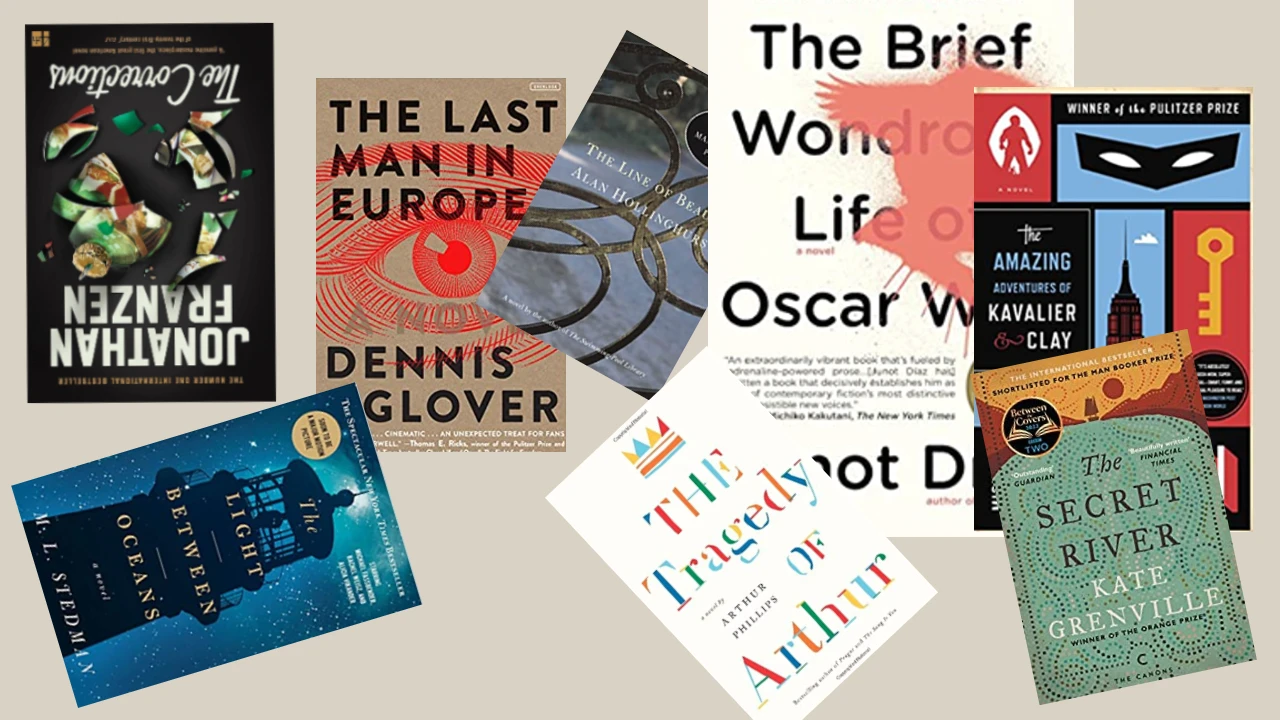
Chosen by a panel of writers rather than a board, the National Book Award often crowns the braver, stranger American book, and it makes a fine counterweight to the Pulitzer. Jesmyn Ward’s Sing, Unburied, Sing carries the ghosts of the Mississippi past into a present of poverty and love, in a prose that verges on the incantatory. Jonathan Franzen’s The Corrections remains the great tragicomic novel of the American family at the turn of the millennium, and Denis Johnson’s Tree of Smoke is a sprawling, hallucinatory reckoning with the Vietnam War and the loss of American innocence.
The complete list is at National Book Award winners.
The Women’s Prize for Fiction, founded to correct the long neglect of women writers by the older awards, has one of the most reliably rewarding rolls of any prize. Chimamanda Ngozi Adichie’s Half of a Yellow Sun, later named the prize’s “Winner of Winners,” tells the story of the Biafran war through a handful of unforgettable lives and remains the essential novel of modern Nigeria. Madeline Miller’s The Song of Achilles retells the Iliad as a love story and made an ancient tragedy feel newly urgent, and Ann Patchett’s Bel Canto turns a hostage crisis into a strange, tender opera about art and captivity.
Here is where an award becomes something more than a national honor: a bridge across languages, and the surest way for an English reader to find the books the rest of the world is already reading. Since 2016 the International Booker Prize has been the clearest annual map of the best fiction in translation, splitting its award equally between author and translator, and its ten winners so far form a reading list of their own.
Start with the two that reshaped the prize’s reputation. Han Kang’s The Vegetarian, the inaugural winner and later the work of a Nobel laureate, is a quiet act of violence about a woman who simply stops eating meat and will not be talked out of it. Olga Tokarczuk’s Flights treats the novel as a constellation of fragments about bodies and travel, and confirmed that the prize would reward the genuinely experimental. The winners that followed carried the map ever wider: David Grossman’s A Horse Walks into a Bar stages a comedian’s onstage breakdown as a reckoning with grief, and Jokha Alharthi’s Celestial Bodies became the first novel written in Arabic to win, a subtle chronicle of three Omani sisters and a country shedding its past.
The recent laureates are among the most exciting fiction being translated today. Marieke Lucas Rijneveld’s The Discomfort of Evening renders a Dutch farming family’s grief with unflinching strangeness, and David Diop’s At Night All Blood Is Black descends into the mind of a Senegalese soldier in the trenches of the First World War, a short novel of terrible force. Geetanjali Shree’s Tomb of Sand, the first Hindi novel to win, follows an eighty-year-old woman who rises from depression into a new life at the Partition border, and Georgi Gospodinov’s Time Shelter, the first Bulgarian winner, imagines a clinic that recreates the past for those who wish to live there. Jenny Erpenbeck’s Kairos traces a doomed love affair against the collapse of East Germany, and the newest winner, Banu Mushtaq’s Heart Lamp, translated from Kannada, is the first collection of short stories to take the prize, twelve tales of women’s lives in southern India.
Beyond the International Booker, the great national prizes open doors of their own, and these are the ones an English reader can now follow. Mohamed Mbougar Sarr’s The Most Secret Memory of Men won France’s Prix Goncourt and is a dazzling literary detective story about a lost African masterpiece, while Kamel Daoud’s Houris, a more recent Goncourt winner, confronts the Algerian civil war through the voice of a woman who survived it. Mircea Cărtărescu’s Solenoid, which took the Dublin Literary Award, is a vast Romanian dream of a novel unlike anything else in contemporary fiction. And for the older masters whom the Nobel first carried into English, Yasunari Kawabata’s Snow Country and Naguib Mahfouz’s The Cairo Trilogy remain the essential gateways to the Japanese and Arabic traditions.
For the reader who wants to go further into this world, our guide to world literature and to magical realism maps the territory these prizes only begin to chart.
Faced with a list this long, the overwhelmed reader should simply begin somewhere true. For the modern classic that has already won every argument, read Toni Morrison’s Beloved. For the translated masterpiece that opens the wider world, read Han Kang’s The Vegetarian. And for a recent winner that proves the prizes are still finding greatness, read Geetanjali Shree’s Tomb of Sand. Three books, three continents, three different ideas of what a novel can do.
The prizes are a beginning, never a conclusion. They gather the flood into something a reader can navigate, and then they hand the real work back to us, which is to read, to judge, and to disagree. The best reading life is spent quarreling with the juries, chasing the book they overlooked, defending the winner everyone else has forgotten. Follow the awards, by all means, but follow them the way a traveler uses a map, as a way of finding the road, not a reason to stop walking.