Newsletter Subscribe
Enter your email address below and subscribe to our newsletter



This content may contain affiliate links. When you buy through these links, we may earn an affiliate commission.
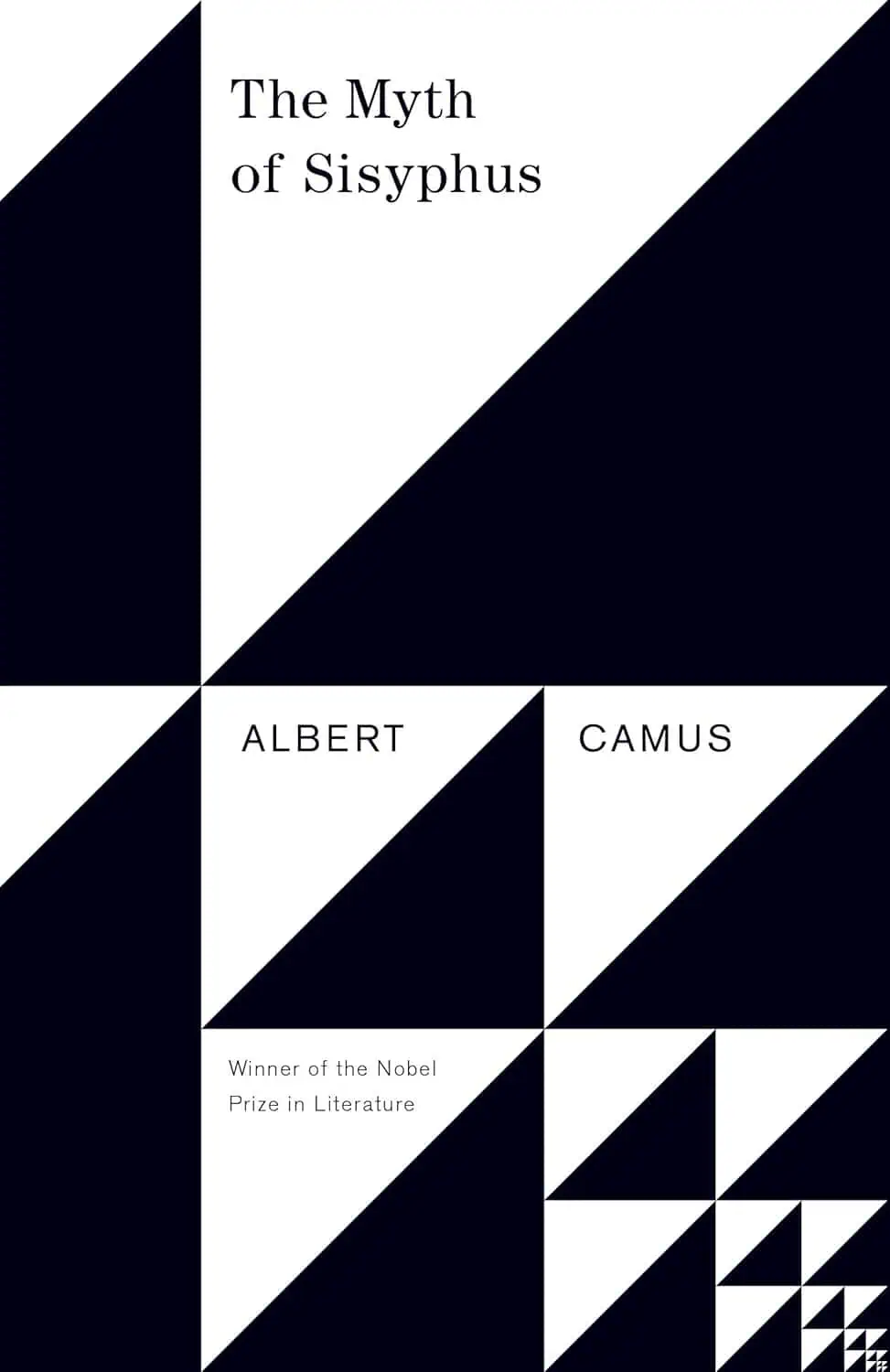
The Myth of Sisyphus is a philosophical essay by Albert Camus, published in 1942. In it, Camus builds the foundation of his philosophy of the absurd – the collision between humanity’s desperate need for meaning and a universe that offers none. The essay is divided into four parts: absurd reasoning, the absurd man, absurd creation, and the myth of Sisyphus itself. It remains one of the most lucid and unsettling works of twentieth-century philosophy, and its final line — “One must imagine Sisyphus happy” — has never stopped demanding an answer.
Sisyphus is better known for his punishment than for his life, but both matter to Camus.
In Greek mythology, Sisyphus was the king of Corinth — cunning, ambitious, and contemptuous of the gods. His punishment was deceptively simple: he was condemned to push a boulder to the top of a mountain for eternity, only for it to roll back down each time he neared the summit. The gods understood that endless futile labor was a more terrible punishment than any physical torment.
There are two main accounts of how he earned this fate. In the first, Zeus abducted Aegina, daughter of the river god Asopus. Sisyphus witnessed the abduction and struck a bargain: he told Asopus who had taken his daughter in exchange for a freshwater spring for Corinth’s citadel. By betraying Zeus, Sisyphus won earthly prosperity for his people at the cost of divine wrath.
In the second account, Sisyphus instructed his wife to skip his funeral rites when he died. On arriving in the underworld, he complained to Hades that his wife had neglected her duties and was granted permission to return to earth to set things right. Once back among the living, he simply refused to return, living to old age before finally being dragged back to face his eternal sentence.
What fascinates Camus is not the punishment itself but Sisyphus’s state of mind during the descent — the walk back down the mountain, knowing exactly what awaits him. It is in that moment, Camus argues, that Sisyphus becomes something more than a condemned man.
Camus opens the essay with a provocation: the only truly serious philosophical question is suicide. Not in a clinical sense, but as a logical one. If life has no meaning, why continue living? This, he argues, is the fundamental question philosophy has always skirted around.
The absurd, for Camus, is not a property of the world or of human beings in isolation. It arises in the confrontation between the two — between our hunger for clarity, meaning, and purpose, and the world’s complete silence in response. He describes the moment of recognition in the most ordinary terms:
“Rising, tramway, four hours of work at the office or factory, meal, tramway, four hours of work, meal, sleep, and Monday, Tuesday, Wednesday, Thursday, Friday, and Saturday all in the same rhythm — this path is easily followed most of the time. But one day the ‘why’ arises, and everything begins in that weariness tinged with amazement.”
That moment of “why” is the encounter with the absurd. It cannot be cured, reasoned away, or solved by religion. Camus insists it must be lived with, eyes open.
He identifies three consequences of accepting the absurd: revolt (constant confrontation rather than surrender), freedom (the liberation that comes from abandoning false hopes), and passion (an enthusiastic embrace of life precisely because it is finite and meaningless). Suicide, he argues, is not a response to the absurd — it is a capitulation to it.
Camus identifies Sisyphus as the perfect embodiment of the absurd hero, both in his life and in his punishment. During his life he showed contempt for the gods, hatred of death, and an overwhelming passion for earthly existence. In death he was given a punishment designed to break exactly that spirit — a hopeless, endless, pointless labor.
What the gods miscalculated is consciousness. Sisyphus knows his fate. He understands it completely. And it is precisely that lucidity — that unflinching awareness of his condition — that places him beyond their reach.
Camus is especially interested in the descent. After the boulder rolls back down, Sisyphus walks back down the mountain to begin again. It is a brief interval of freedom. He has no rock to push. He has only thought. And in that moment, he is stronger than his punishment:
“There is no fate that cannot be surmounted by scorn.”
The worker who performs the same tasks every day without reflection is, Camus argues, no different from Sisyphus — except that Sisyphus is conscious of it. Tragic awareness is not a curse; it is the only form of dignity available to us.
Camus illustrates the three faces of the absurd man through three types: the lover, the actor, and the conqueror.
The lover pursues fleeting joy while knowing it is transient. The actor inhabits multiple lives in a single lifetime, knowing every role is an illusion. The conqueror acts decisively, refusing to moralize, knowing that decisive action is its own justification. Each, in their way, embraces experience without demanding that it yield permanent meaning.
Art, too, belongs here. Camus argues that great art neither explains nor resolves the absurd — it describes existence with full awareness of its futility. The artist who creates knowing the work is temporary and ultimately meaningless is, paradoxically, making the fullest use of a human life.
The three responses all point to the same imperative: live more, not less. Recognize the absurd and then refuse to be diminished by it. Revolt, in particular, would not stay contained within the absurd. A decade later Camus expanded it into a full moral and political argument in The Rebel, asking what the defiance born here permits us to do to one another.
This is the essay’s final sentence and its most contested claim. Why must we imagine Sisyphus happy? Camus’s phrasing is deliberate — it is not that Sisyphus is happy, or that happiness is easy, but that we must imagine it. The logic runs as follows.
If true happiness is possible for human beings, it must be achievable through experience — not through faith, hope, or the promise of something better after death. If Sisyphus, the man in the most extreme possible condition of futile suffering, cannot be happy through consciousness alone, then happiness itself is a kind of lie — a comfort available only to those who look away.
Sisyphus can only be happy if he accepts his fate entirely — not with resignation, but with scorn. When he stops measuring his boulder against some imagined alternative, the gods lose their power to punish him. The rock is no longer his grief; it is simply his life. And his life, however absurd, is entirely his own.
Camus draws the same argument from Oedipus, who after discovering the full horror of what he has done — killing his father, marrying his mother — still concludes: “Despite so many ordeals, my advanced age and the nobility of my soul make me conclude that all is well.” Not because things are well, but because acceptance is the only authentic response to a fate we cannot change.
“Happiness and the absurd are two sons of the same earth.”
Sisyphus symbolizes the human condition in its most essential form: the conscious being trapped in repetitive, purposeless existence who must nevertheless find a way to live.
In Greek mythology he represented hubris — the mortal who dared to outwit the gods and paid eternally for it. In Camus’s reading, he becomes something almost opposite: a symbol of defiance, lucidity, and the strange dignity available to anyone who accepts their fate without flinching.
His boulder is not unique to him. Every person who drags themselves to work on a Monday morning, who performs the same tasks knowing they will be repeated tomorrow and the day after, carries a version of it. The question Camus asks is not how to put the boulder down. It is how to carry it consciously — and in that consciousness, to become stronger than it.
“There is but one truly serious philosophical problem, and that is suicide.”
“The absurd is born of the confrontation between the human need and the unreasonable silence of the world.”
“To live, naturally, is never easy. You continue to perform the gestures commanded by existence for many reasons, the first of which is habit.”
“There is no fate that cannot be surmounted by scorn.”
“Happiness and the absurd are two sons of the same earth.”
“One must imagine Sisyphus happy.”