Newsletter Subscribe
Enter your email address below and subscribe to our newsletter


This content may contain affiliate links. When you buy through these links, we may earn an affiliate commission.
Spanish is one of the two or three great literary languages of the world, and it has the rare distinction of holding two capitals at once. It gave the world the first modern novel, in a Spain of windmills and delusion, and four centuries later it gave the world the most influential novel of the twentieth century, in a Colombia of ice and insomnia. To read across Spanish-language fiction is to travel between two continents that share a tongue but not a history, and to watch that shared language do utterly different work in each.
This guide gathers the best Spanish-language novels, drawn from both Spain and Latin America, arranged so that a reader can trace the tradition from its foundation in the Golden Age to the writers publishing now. Nearly every title here is available in a fine English translation, which means this is a literature an English reader can actually enter, not merely admire from outside. It belongs to our larger guide to world literature, and it draws deeply on the traditions we explore in Latin American writing.
Spanish literature is the body of writing produced in the Spanish language across Spain and the Spanish-speaking Americas, and its unusual power comes from that double geography. For most of its history the tradition ran through Spain, from the medieval epics and the Golden Age of Cervantes to the great realists of the nineteenth century. Then, in the twentieth century, the center of gravity crossed the Atlantic, and the novelists of Latin America seized the language and remade it, giving it a new appetite for the marvelous, the political, and the vast. Today the two traditions are in constant conversation, and a reader who follows the language rather than the border gains both.
The result is a literature with a distinctive temperament: baroque in its love of the sentence, unafraid of the fantastic, and forever alert to the pressure of history on private life. It is the language in which the boundary between the real and the imagined is most porous, which is why it produced magical realism, and it has been honored with eleven Nobel Prizes in Literature, more than almost any language but English. For the reader ready to begin, the difficulty is not finding a masterpiece but choosing which one to open first.
Spanish fiction was doing revolutionary work before most of Europe had a novel at all. The form’s deep root is the picaresque, and its founding text is the anonymous Lazarillo de Tormes of 1554, the sharp, funny, bitter tale of a poor boy who serves a series of masters and learns that survival means cunning. It invented the roguish first-person voice that the novel has never stopped using. Even earlier, Fernando de Rojas’s La Celestina of 1499, a tragicomedy told almost entirely in dialogue, had pushed prose fiction toward psychological depth centuries ahead of its time.
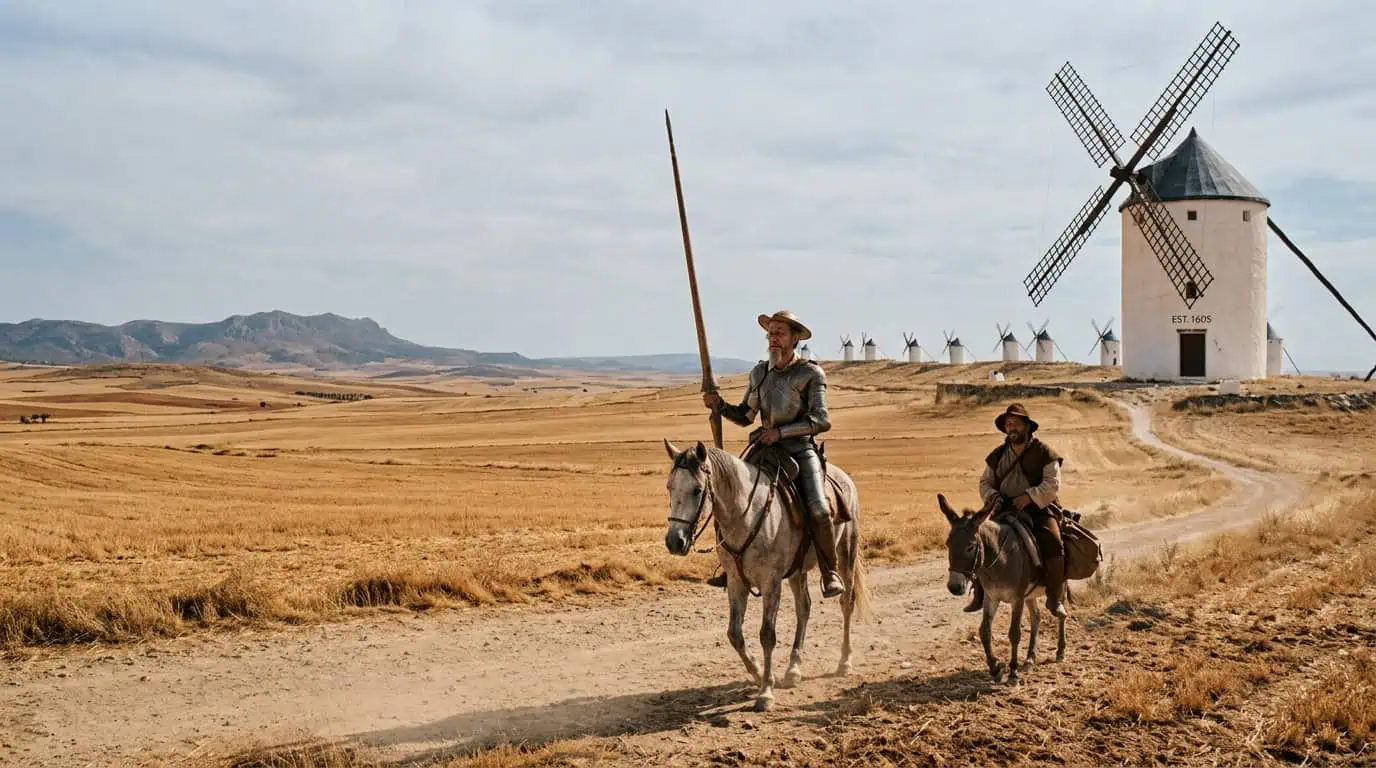
Everything crests with Miguel de Cervantes and Don Quixote, published in two parts in 1605 and 1615 and still, by common consent, the first modern novel and one of the greatest ever written. The story of an aging gentleman who reads too many chivalric romances and rides out to revive knight-errantry in a world that has no use for it is at once the funniest and the most melancholy of books, and it invented nearly everything the novel would later learn to do, the unreliable telling, the play between illusion and reality, the deep comedy of a mind at odds with the world. Every Spanish-language writer who followed has written in its shadow, and a surprising number have written directly back to it.
Before the Latin American century, Spain produced realist masters to rival the French and the Russians, and they remain unjustly under-read in English. Benito Pérez Galdós, often called the Spanish Balzac, gave Madrid its great social panorama in Fortunata and Jacinta, the sweeping story of two women, one respectable and one not, bound to the same feckless man, a novel as generous and capacious as the city it maps. Its only rival is Leopoldo Alas, who wrote under the name Clarín, whose La Regenta is the Spanish answer to Madame Bovary, the story of a stifled woman in a provincial cathedral town rendered with merciless and beautiful precision. Together they prove that the Spanish novel did not sleep between Cervantes and the twentieth century.
The single most important event in Spanish-language fiction since Cervantes was the flowering of the 1960s and 1970s that the world came to call the Boom, when a generation of Latin American novelists conquered the international stage almost at once. Several became Nobel laureates, and their books remain the essential core of any Spanish-language reading list.
Begin with Gabriel García Márquez’s One Hundred Years of Solitude, the chronicle of the Buendía family in the invented town of Macondo, the summit of the whole tradition and the book that taught the world a new way of telling time. Juan Rulfo’s spare, haunted Pedro Páramo, a novel of a village peopled entirely by the dead, is the strange foundation beneath it, the book García Márquez claimed to know by heart. Jorge Luis Borges, whose genius was the story rather than the novel, belongs here for Ficciones, the collection of labyrinths and infinite libraries that reshaped how the world imagined fiction itself.
The Boom’s other giants are indispensable. Mario Vargas Llosa’s The Feast of the Goat dissects a Caribbean dictatorship with surgical control, the finest door into a Nobel laureate’s vast body of work. Julio Cortázar’s Hopscotch is the great experimental novel of the movement, a book that invites the reader to shuffle its chapters and remake it in the reading. Carlos Fuentes’s The Death of Artemio Cruz tells the story of modern Mexico through the deathbed memories of a corrupt magnate. Behind them all stands the Cuban Alejo Carpentier, whose theory of “the marvelous real” gave the whole movement its philosophical charter.
The generation that followed the Boom broadened its inheritance and carried it to new readers. Isabel Allende’s The House of the Spirits took the magical family saga and turned it toward the female line and the coming catastrophe of Chile’s dictatorship, becoming one of the most beloved novels in the language. Manuel Puig’s Kiss of the Spider Woman built an entire novel from the conversations of two cellmates, a revolutionary and a gay window-dresser, in a book that smuggled pop culture and radical tenderness into serious fiction. And José Donoso’s The Obscene Bird of Night is the great nightmare of the tradition, a hallucinatory masterpiece for the reader ready to be unsettled.
While Latin America was remaking the novel, Spain was producing masters of its own, and the peninsular tradition rewards the reader who seeks it out. Miguel de Unamuno’s Mist anticipated the games of modernism when its hero walks off the page to confront his own author about whether he may be allowed to live. Camilo José Cela, who won the Nobel Prize in 1989, gave the postwar era its defining portrait in The Hive, a mosaic of hundreds of hungry, frightened lives in the Madrid of the years after the civil war, while Miguel Delibes distilled a marriage and a whole repressed society into a single grieving monologue in Five Hours with Mario.
The modern Spanish novel reaches its heights in Javier Marías, the most admired stylist of recent decades, whose A Heart So White is a hypnotic novel of secrets and complicity built from some of the longest and most beautiful sentences in contemporary fiction. Javier Cercas turned the buried memory of the civil war into a genre of its own in Soldiers of Salamis. And for the reader who wants to be swept away, Carlos Ruiz Zafón’s The Shadow of the Wind, set in a gothic postwar Barcelona and built around a Cemetery of Forgotten Books, is the most beloved Spanish novel of the century and the perfect gateway drug to the whole tradition.
The tradition is more alive now than it has been in decades, and much of the most exciting new work reaches English quickly, often by way of the International Booker Prize. The bridge from the Boom to the present is Roberto Bolaño, whose The Savage Detectives follows two doomed poets across continents and decades and reinvented the Latin American novel for a new generation; his posthumous 2666 is the darker, vaster masterpiece for those who fall under his spell.
The writers who have followed him are remaking the language yet again. Many are women turning the tradition’s taste for the uncanny toward new and unsettling ends: Fernanda Melchor circles a killing in rural Mexico in a torrent of furious, unbroken prose in Hurricane Season, Mariana Enríquez fuses Argentine history with genuine horror in the sprawling gothic epic Our Share of Night, and Samanta Schweblin’s Fever Dream is a short, terrifying novel of motherhood and ecological dread that can be read in a sitting and not forgotten for years. Alongside them, Yuri Herrera’s slender Signs Preceding the End of the World reimagines the border crossing as a journey into the underworld, and Juan Gabriel Vásquez’s The Sound of Things Falling reckons with the long shadow of the Colombian drug war. The language has never been in better health.
Faced with four centuries and two continents, the new reader should simply begin somewhere true. For the modern masterpiece that has already won every argument, read One Hundred Years of Solitude. For the strange, short, foundational book that makes the whole tradition legible, read Pedro Páramo. And for pure pleasure and a soft landing, read The Shadow of the Wind. Three books, two continents, and every reason to keep going.
Return, at the end, to the double capital with which we began. What makes Spanish-language fiction inexhaustible is precisely that it is not one tradition but two in conversation, the old world and the new, the peninsula and the vast Americas, each holding the same language and asking it to do different work. To read across it is to travel without ever leaving the tongue, from Cervantes’s dusty plains to Macondo’s endless rain to the haunted cities of the writers working now. The shelf is long, the translations are excellent, and the only question that remains is where to begin.