Newsletter Subscribe
Enter your email address below and subscribe to our newsletter


This content may contain affiliate links. When you buy through these links, we may earn an affiliate commission.
If the Pulitzer is decided in a boardroom, the National Book Award is decided in an argument among writers, and it shows. Since 1950 the fiction award has been chosen by panels of novelists and critics rather than administrators, and the result is a roll of honor that leans, more often than its great rival, toward the difficult, the formally daring, and the not-yet-comfortable. It is the prize writers themselves have most wanted to win, and its list of laureates reads like an alternative history of the American novel, drawn by the people who make them.
This page holds that history in full, from Nelson Algren in 1950 to Rabih Alameddine in 2025, along with the story of how the award works, the strange years when it nearly lost its way, and the winning novels most worth a reader’s time. The National Book Award has crowned monuments and provocations in equal measure, and part of its interest is how often it has been braver than the safer prizes. It is one entry in our guide to the most prestigious literary awards in the world, and the essential companion to the Pulitzer Prize for Fiction.
The National Book Award is given each year to the finest work of fiction by an American author, published in the United States. It was founded in 1950 by the American book trade, and it is now administered by the National Book Foundation, which stages its awards each November at a black-tie ceremony in New York that functions as the closest thing American letters has to a night at the Oscars. The winner receives a bronze sculpture, a modest cash prize, and the lasting authority of having been chosen by a jury of working writers.
That last point is the key to the award’s character. Where the Pulitzer’s final verdict rests with a board, the National Book Award is decided by a panel of five judges drawn largely from the ranks of authors, and writers tend to reward the books that expand what the novel can do rather than the ones that console. The two prizes often disagree, and when they agree, as they did in 2024, when Percival Everett’s James took both, the double laurel is a rare mark of consensus. The award has not always been a model of restraint, and its history includes one long, chaotic detour that nearly undid it, but its instinct for the bold has made it, for many writers, the more coveted honor of the two.
The 2025 National Book Award for Fiction went to Rabih Alameddine for The True True Story of Raja the Gullible (and His Mother), a novel of a philosophy teacher and his aging, sharp-tongued mother that turns a domestic comedy into something searching and strange. Alameddine, born in Jordan to a Lebanese family and long resident in the United States, is among the most inventive of contemporary American voices.
It follows a run of notable winners. The 2024 award went to Percival Everett’s James, which also took the Pulitzer, and the 2023 prize to Justin Torres’s Blackouts, a genre-defying meditation on queer history and erasure. This section is updated each November, when the new winner is announced.
The record below runs most recent first, grouped by decade. In three years in the 1970s the award was shared between two novels, and those ties are noted. From 1980 to 1986 the award, then briefly renamed the American Book Awards, split fiction across multiple categories; the winner listed for those years is the principal hardcover fiction award.
| Year | Winner | Author |
|---|---|---|
| 2025 | The True True Story of Raja the Gullible (and His Mother) | Rabih Alameddine |
| 2024 | James | Percival Everett |
| 2023 | Blackouts | Justin Torres |
| 2022 | The Rabbit Hutch | Tess Gunty |
| 2021 | Hell of a Book | Jason Mott |
| 2020 | Interior Chinatown | Charles Yu |
| Year | Winner | Author |
|---|---|---|
| 2019 | Trust Exercise | Susan Choi |
| 2018 | The Friend | Sigrid Nunez |
| 2017 | Sing, Unburied, Sing | Jesmyn Ward |
| 2016 | The Underground Railroad | Colson Whitehead |
| 2015 | Fortune Smiles | Adam Johnson |
| 2014 | Redeployment | Phil Klay |
| 2013 | The Good Lord Bird | James McBride |
| 2012 | The Round House | Louise Erdrich |
| 2011 | Salvage the Bones | Jesmyn Ward |
| 2010 | Lord of Misrule | Jaimy Gordon |
| Year | Winner | Author |
|---|---|---|
| 2009 | Let the Great World Spin | Colum McCann |
| 2008 | Shadow Country | Peter Matthiessen |
| 2007 | Tree of Smoke | Denis Johnson |
| 2006 | The Echo Maker | Richard Powers |
| 2005 | Europe Central | William T. Vollmann |
| 2004 | The News from Paraguay | Lily Tuck |
| 2003 | The Great Fire | Shirley Hazzard |
| 2002 | Three Junes | Julia Glass |
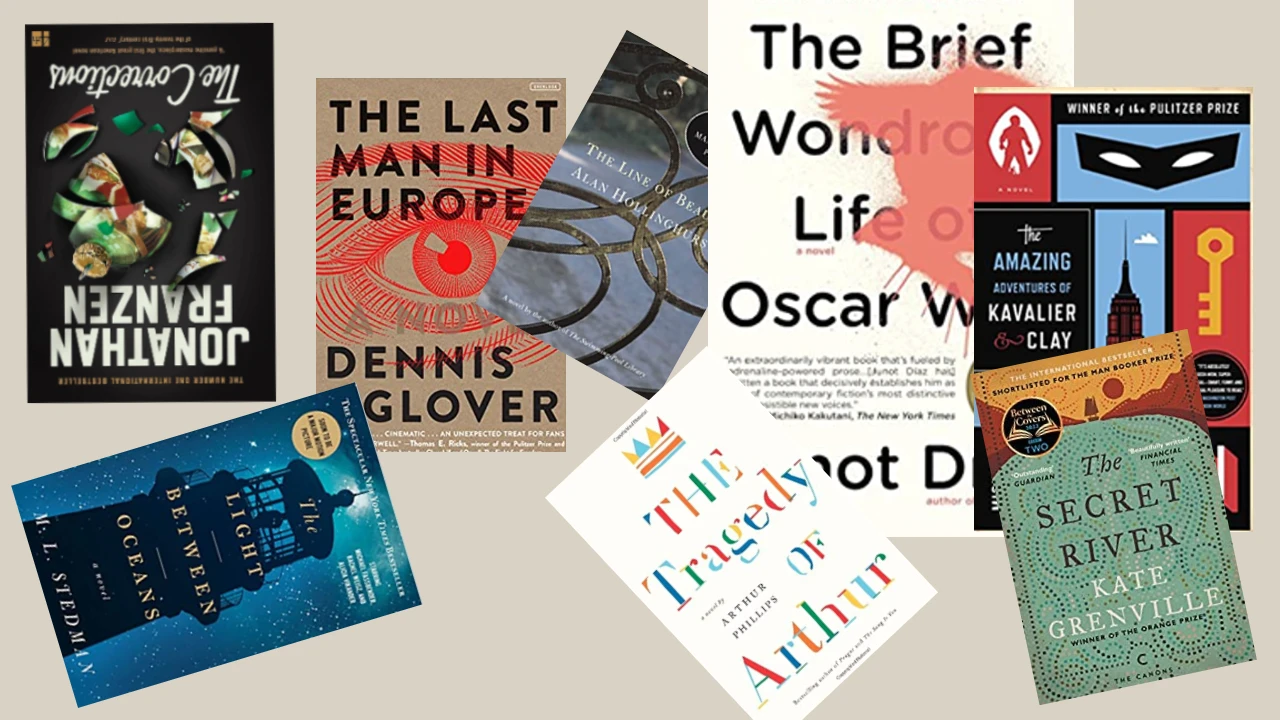
| 2001 | The Corrections | Jonathan Franzen |
| 2000 | In America | Susan Sontag |
| Year | Winner | Author |
|---|---|---|
| 1999 | Waiting | Ha Jin |
| 1998 | Charming Billy | Alice McDermott |
| 1997 | Cold Mountain | Charles Frazier |
| 1996 | Ship Fever and Other Stories | Andrea Barrett |
| 1995 | Sabbath’s Theater | Philip Roth |
| 1994 | A Frolic of His Own | William Gaddis |
| 1993 | The Shipping News | E. Annie Proulx |
| 1992 | All the Pretty Horses | Cormac McCarthy |
| 1991 | Mating | Norman Rush |
| 1990 | Middle Passage | Charles Johnson |
| Year | Winner | Author |
|---|---|---|
| 1989 | Spartina | John Casey |
| 1988 | Paris Trout | Pete Dexter |
| 1987 | Paco’s Story | Larry Heinemann |
| 1986 | World’s Fair | E. L. Doctorow |
| 1985 | White Noise | Don DeLillo |
| 1984 | Victory Over Japan | Ellen Gilchrist |
| 1983 | The Color Purple | Alice Walker |
| 1982 | Rabbit Is Rich | John Updike |
| 1981 | Plains Song | Wright Morris |
| 1980 | Sophie’s Choice | William Styron |
| Year | Winner | Author |
|---|---|---|
| 1979 | Going After Cacciato | Tim O’Brien |
| 1978 | Blood Tie | Mary Lee Settle |
| 1977 | The Spectator Bird | Wallace Stegner |
| 1976 | J R | William Gaddis |
| 1975 | Dog Soldiers (shared) | Robert Stone |
| 1975 | The Hair of Harold Roux (shared) | Thomas Williams |
| 1974 | Gravity’s Rainbow (shared) | Thomas Pynchon |
| 1974 | A Crown of Feathers (shared) | Isaac Bashevis Singer |
| 1973 | Chimera (shared) | John Barth |
| 1973 | Augustus (shared) | John Williams |
| 1972 | The Complete Stories | Flannery O’Connor |
| 1971 | Mr. Sammler’s Planet | Saul Bellow |
| 1970 | them | Joyce Carol Oates |
| Year | Winner | Author |
|---|---|---|
| 1969 | Steps | Jerzy Kosinski |
| 1968 | The Eighth Day | Thornton Wilder |
| 1967 | The Fixer | Bernard Malamud |
| 1966 | The Collected Stories of Katherine Anne Porter | Katherine Anne Porter |
| 1965 | Herzog | Saul Bellow |
| 1964 | The Centaur | John Updike |
| 1963 | Morte d’Urban | J. F. Powers |
| 1962 | The Moviegoer | Walker Percy |
| 1961 | The Waters of Kronos | Conrad Richter |
| 1960 | Goodbye, Columbus | Philip Roth |
| Year | Winner | Author |
|---|---|---|
| 1959 | The Magic Barrel | Bernard Malamud |
| 1958 | The Wapshot Chronicle | John Cheever |
| 1957 | The Field of Vision | Wright Morris |
| 1956 | Ten North Frederick | John O’Hara |
| 1955 | A Fable | William Faulkner |
| 1954 | The Adventures of Augie March | Saul Bellow |
| 1953 | Invisible Man | Ralph Ellison |
| 1952 | From Here to Eternity | James Jones |
| 1951 | The Collected Stories of William Faulkner | William Faulkner |
| 1950 | The Man with the Golden Arm | Nelson Algren |
Three quarters of a century of winners is a formidable shelf, and the National Book Award, with its taste for the ambitious, has crowned some of the most demanding books in American fiction alongside some of the most beloved. A few are indispensable.
Begin with Ralph Ellison’s Invisible Man, the 1953 winner and one of the essential American novels of the century, a furious, virtuosic account of a Black man’s passage through a country that refuses to see him. For the short story at its most perfect, Flannery O’Connor’s The Complete Stories, awarded posthumously in 1972, has no equal in American letters. The prize’s boldness is nowhere clearer than in its 1974 award to Thomas Pynchon’s Gravity’s Rainbow, the great encyclopedic novel of the paranoid century, a book the Pulitzer’s board had recoiled from the year before.
For readers who prefer their greatness more approachable, Cormac McCarthy’s All the Pretty Horses is the most inviting door into his work, a lyrical border western of youth and loss, and Charles Frazier’s Cold Mountain turned a Confederate deserter’s long walk home into one of the most cherished novels of the 1990s. Jonathan Franzen’s The Corrections remains the definitive tragicomedy of the American family at the millennium. And for the contemporary prize at its most vital, read Jesmyn Ward, the first woman to win the fiction award twice, whose Sing, Unburied, Sing carries the ghosts of Mississippi into a haunted present, alongside Percival Everett’s James, the rare novel to sweep both this prize and the Pulitzer.
The National Book Award’s strangest chapter came in the early 1980s, when the industry, hungry for the glamour and sales power of the Oscars, remade the award as the American Book Awards and multiplied its categories into a sprawl of prizes for hardcover and paperback, first novels, and much else, complete with a televised ambition few wanted. Writers rebelled, boycotts followed, and by 1987 the whole apparatus had been dismantled and the award restored to something like its old dignity. The prize has courted milder controversy too, from its willingness to crown difficult books the public would never finish to the celebrated moment in 1974 when the reclusive Thomas Pynchon, refusing to appear, sent the comedian Irwin Corey to accept in his place, who delivered a gloriously nonsensical speech to a baffled room. The honest reader will see in all of this the sign of a prize that has never entirely tamed itself, which is precisely its virtue. It remains the award most willing to be wrong in interesting ways.
Return, at the end, to the difference with which this began: a prize decided not by a board but by writers, arguing among themselves about what the novel is for. That origin explains everything about the list, its appetite for risk, its patience with difficulty, its recurring preference for the book that unsettles over the book that reassures. The winners gathered here are not a safe canon but a working argument, the record of what American novelists have most admired in one another across seventy-five years. Read against the Pulitzer, the National Book Award offers the more adventurous map of the same territory, and for many readers it is the truer one.