
Newsletter Subscribe
Enter your email address below and subscribe to our newsletter


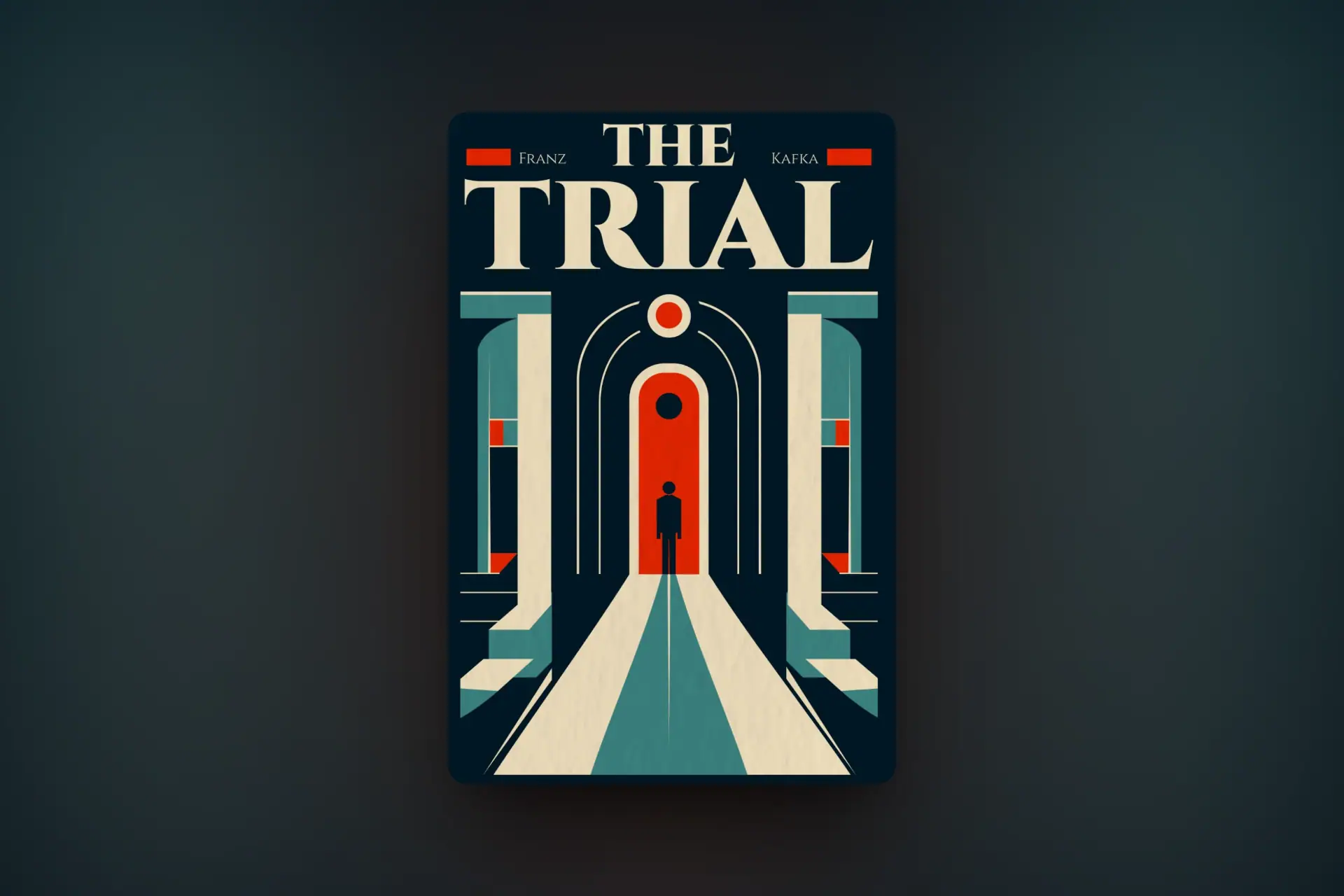
This content may contain affiliate links. When you buy through these links, we may earn an affiliate commission.
When Franz Kafka read the first chapter of The Trial aloud to a few friends in Prague, Max Brod remembered, he laughed so hard that at moments “he couldn’t read any further.” The chapter he was reading is the one in which a bank clerk wakes on the morning of his thirtieth birthday to find strangers in his room, eating his breakfast and informing him that he is under arrest, for no reason anyone will give. “Someone must have slandered Josef K.,” the novel begins, in Breon Mitchell’s translation, and for a century readers have treated what follows as the darkest book of the modern age. Its author thought it was funny.
Both reactions are right, and the novel cannot be understood without holding them together. The Trial is a comedy of manners conducted inside a nightmare: a story about a man who is never told his crime, never finds the court that judges him, and never meets the authority that will finally have him killed, yet who argues, petitions, hires lawyers, and behaves at every turn like a man half convinced that the accusation, whatever it is, must somehow be just. Its true subject is not the law but guilt, the strange conviction of guilt that seems to arrive before any crime and require no evidence. Kafka wrote it in 1914 and 1915 and abandoned it unfinished; it was published only in 1925, a year after his death, by a friend who disobeyed his instruction to burn it. What survived gave the language a word, kafkaesque, and gave the century one of its central images of itself. What follows tells the whole story, so readers who want to be surprised should read the novel first.
Josef K. is a senior clerk at a bank, proud of his position, living in a boarding house run by Frau Grubach. The two warders who arrest him are oddly casual about it; they eat his breakfast, try to take his underclothes, and tell him that he is under arrest but free to go on working as usual. That evening he waits up for the young woman in the next room, Fräulein Bürstner, to tell her about it, and ends the night by kissing her like a thirsty animal, an episode he will not be able to forget. He receives a summons to a hearing on Sunday, with no time given, at an address in a working-class suburb that turns out to be a tenement, and finds the court in session in an attic room full of men in black coats, where he delivers a ringing speech against the whole corrupt proceeding and storms out, only to learn that by doing so he has damaged a case whose rules he cannot discover.
From there the court spreads through his life. Opening a storeroom at his own bank, he finds the two warders being flogged because he complained about them, and when he opens the door again the next evening the same scene is still going on. His uncle, alarmed for the family name, takes him to the advocate Huld, a sick old lawyer who conducts business from his bed and talks endlessly without doing anything, and whose nurse, Leni, is attracted to accused men because, she says, their guilt makes them beautiful. The court painter Titorelli explains the three possible outcomes: definite acquittal, which no one has ever actually witnessed; apparent acquittal, which can be revoked at any time; and indefinite postponement, which keeps the case alive forever at a low simmer. Then he sells K. three identical paintings of a heath. In Huld’s house K. meets Block, a tradesman who has been an accused man for five years and has been reduced by his devotion to his lawyer to a cringing, dog-like creature who kneels at the bedside.
Sent by the bank to show an Italian client around the cathedral, K. finds that the client never comes, and instead a priest calls him by name from the pulpit, tells him the parable of the doorkeeper, and argues with him about what it means. On the evening before his thirty-first birthday, two men in frock coats and top hats come for him. He goes with them without resistance, through the city to a quarry on its edge, where one holds him while the other drives a knife into his heart and turns it twice. “Like a dog!” he says, and, in the Muirs’ translation, “it was as if the shame of it must outlive him.”
The novel was born out of a broken engagement. In July 1914, in a room at the Askanischer Hof hotel in Berlin, Kafka’s fiancée, Felice Bauer, confronted him with her sister and two friends and ended their engagement, while he sat and said almost nothing. He called the scene, in his diary, a tribunal. Within weeks, as Europe went to war, he began writing The Trial, working at night after his days at the Workers’ Accident Insurance Institute in Prague. Elias Canetti, in Kafka’s Other Trial (1969), argued that the emotional substance of both events went straight into the novel: the engagement became the arrest, and the hotel tribunal the execution. It is a powerful reading and, like all biographical readings of Kafka, a partial one. But it explains something the novel never does: why a man who has done nothing would feel, from the first page, that he has been found out.
Kafka worked on the book until early 1915 and then put it aside. What remained was 161 loose pages torn from notebooks and bundled into chapters, some finished, some fragments, with no settled order. In 1920 he gave the bundle to Max Brod, and before his death from tuberculosis in 1924 he asked Brod to burn it, with everything else he had left unpublished. Brod refused, arranged the finished chapters in the order he judged best, set the fragments aside, and published the novel in 1925. The manuscript itself had its own afterlife: it passed to Brod’s secretary, Esther Hoffe, and was sold at Sotheby’s in London in 1988 to the German Literature Archive in Marbach. Readers should know that the order of the chapters is Brod’s, not Kafka’s, and that the book Kafka meant to write does not exist.
Camus located the absurd in the gap between our hunger for meaning and the silence of the world. Kafka finds something more intimate and, in the end, more frightening. His accused man does not stand bewildered before an indifferent universe; he carries the tribunal inside himself. The apparatus that pursues Josef K., the hidden judges, the endless offices, the warders who cannot say what he has done, is the outward form of a sentence he has already half passed on himself. And because the charge is never named, it can never be answered. A guilt without content is one that no innocence can disprove.
This is why he never simply walks away, though nothing at first prevents him. Left free on every ordinary day, he keeps returning to the court, keeps seeking out its officials, keeps behaving like a man who suspects that somewhere in the machinery there is a charge with his name on it that he cannot quite remember committing. As the trial spreads through his life he begins to scrutinize himself, and it is this creeping self-accusation, more than any executioner, that finally undoes him. The book’s most modern suggestion is that the deepest authority is the one we install in ourselves.
The world Kafka builds around this guilt is as precisely realized a nightmare as modern fiction has produced, and its genius is its shabbiness. The court is not a marble hall of justice but a warren of offices in tenement attics, reached through strangers’ apartments, where laundry hangs beside the benches and the air is so close that petitioners faint. Its officials know nothing of the cases they administer. Its law books, when K. finally opens one, turn out to contain an indecent drawing. Hearings are scheduled without a stated time, so that a man can be told he is late for an appointment no one ever fixed. Proceedings can be dragged out forever but never won.
The system is not cruel so much as impersonal and unanswerable, and it does not need to be cruel, because the people inside it supply the cruelty themselves: the lawyer who keeps his clients in fear, the client who crawls, the painter who sells hope at a price. The novel’s insight, which our essay on kafkaesque books follows through two dozen later writers, is that such a system runs on cooperation. Nobody in The Trial is forced to do anything. They do it because everyone else does.
The novel’s meaning gathers itself into the parable the priest tells in the cathedral, which Kafka thought well enough of to publish on its own in 1915. A man from the country comes seeking admittance to the Law and finds its door open, guarded by a doorkeeper who tells him he cannot enter now, though perhaps later. So the man waits. He waits for years, bribing the doorkeeper, growing old, until at the end of his life he asks why, in all this time, no one else has come to this door. The doorkeeper bellows his answer: no one else could have been admitted here, because, in the Muirs’ version, “this door was intended only for you. I am now going to shut it.”
Then the priest and K. argue about what the story means, and Kafka refuses to settle it. Was the doorkeeper a deceiver or a faithful servant? Was the man a victim of the Law or the author of his own exclusion, since the door stood open all along and he never dared to pass? Is the Law justice, or God, or meaning itself, always available and never reached? The priest offers interpretation after interpretation, each one plausible, each one undermining the last, until K. is too tired to follow. The parable is the whole novel compressed to a point, an entrance that stands open and is never entered, and its irresolution is not a flaw. It is what the book was written to deliver.
Kafka’s laughter over the first chapter is not an eccentricity to be explained away. The novel is full of jokes, deadpan and exact: the warders who eat the accused man’s breakfast, the law books full of dirty pictures, the painter’s three identical heaths, the flogging that is still going on, frozen, when the door is opened a day later. David Foster Wallace, in an essay first published as “Laughing with Kafka” in 1998, admitted that with his students “it is next to impossible to get them to see that Kafka is funny,” and argued that the comedy is the point. The humor of The Trial is the humor of a man treating a catastrophe as an administrative problem, of proceedings conducted with perfect manners toward a perfectly senseless end.
Reading the book as a comedy does not make it less frightening. It makes it more so, because it shows how ordinary the nightmare is. K.’s most absurd moments, his indignant speeches, his fussing over his reputation at the bank, his attempts to seduce whichever woman is nearest to the court, are the behavior of a man who has not grasped what is happening to him, and the reader laughs and then, a little later, recognizes himself.
Few books have been read in so many ways, and most of the readings are true to some part of it. Max Brod read it as a religious allegory, the Law as divine grace that the sinner cannot reach. Others have read it as a prophecy of the bureaucratic state and the totalitarian trials of the century to come, the Moscow show trials and the Gestapo’s arrests that Kafka did not live to see. Psychoanalytic readers have found in the court the father who judges, and Kafka’s own Letter to His Father (1919) gives them plenty of evidence. Canetti found Felice and the hotel room. Camus claimed the book for the absurd, appending an essay on Kafka to The Myth of Sisyphus.
The danger is that each reading, held too tightly, makes the book smaller than it is. Kafka removed every detail that would let it be pinned down: the court has no location, the law no content, the crime no name. That is why it fits so many situations, and also why it resists every attempt to explain it. It is worth adding, honestly, that the unfinished state of the book shows. The middle chapters, the long scenes at Huld’s bedside and with Block, move slowly and repeat themselves, and the order in which we read them is a friend’s guess. The Trial is a masterpiece with its scaffolding still up, and part of its power is that the reader can see where the builder stopped.
Kafka belongs, by common consent, to the literature of the absurd, and setting him beside Camus is illuminating and uncomfortable, because they answer the same darkness so differently. Camus’s Sisyphus, condemned to futile labor, becomes a hero by scorning his fate; one must, Camus insists, imagine Sisyphus happy. Josef K. is condemned too, and he does the opposite. He assents. Led to the quarry, he offers no resistance and dies ashamed. Where the philosophy of absurdism finds a strange freedom in a meaningless world, Kafka finds the guilt and the closing door. Both belong to the conversation mapped in our guide to existentialism and in the existentialist books to read after Camus, where The Trial stands as one of its landmarks.
The opening sentence shows the choice. Willa and Edwin Muir’s translation of 1937, the version through which English readers first met the book, begins “Someone must have traduced Joseph K.,” and it is elegant, a little stately, and made from Brod’s edited text. Breon Mitchell’s translation of 1998, “Someone must have slandered Josef K.,” is based on the restored critical edition of Kafka’s manuscript and keeps closer to his plain, legal, sometimes awkward German, including its long paragraphs and odd punctuation; it is the best choice for most readers today. Idris Parry’s version for Penguin (1994) and Mike Mitchell’s for Oxford World’s Classics (2009) are also reliable, the latter with useful notes. The Muirs’ English has its own beauty, and many readers love it, but it tends to make Kafka sound more literary and more solemn than he is, which is one reason a generation missed the jokes.
Orson Welles filmed The Trial in 1962, with Anthony Perkins as Josef K. and Welles himself as the advocate Hastler, his name for Huld. Shot largely in the abandoned Gare d’Orsay in Paris, it turns Kafka’s attics into vast expressionist spaces of filing cabinets and typists, and Welles later called it the best film he ever made. It is magnificent and not quite Kafka, too grand for a world whose horror is its pettiness. Harold Pinter’s adaptation, filmed in 1993 with Kyle MacLachlan, is closer to the book’s dry comedy. Neither has displaced the novel, whose images, the open door, the attic court, the quarry, have become part of how the modern world describes its own fears.
Kafka laughed as he read the opening, and the laughter is where the book should be left. It is the laughter of a man who could see, more clearly than anyone, how absurd it is to be accused of nothing, to argue with no one, to wait at an open door for permission that will never come, and who could also see that he would have done the same. What lingers after the knife is not outrage at an injustice, because Kafka withholds even the certainty that an injustice was done. It is a question the book presses quietly on every reader: how much of the machinery that torments us have we assembled ourselves, consented to, and dignified with the name of fate? The man from the country was never forbidden the Law. He was only afraid to enter, and the fear was enough.