
Newsletter Subscribe
Enter your email address below and subscribe to our newsletter


This content may contain affiliate links. When you buy through these links, we may earn an affiliate commission.
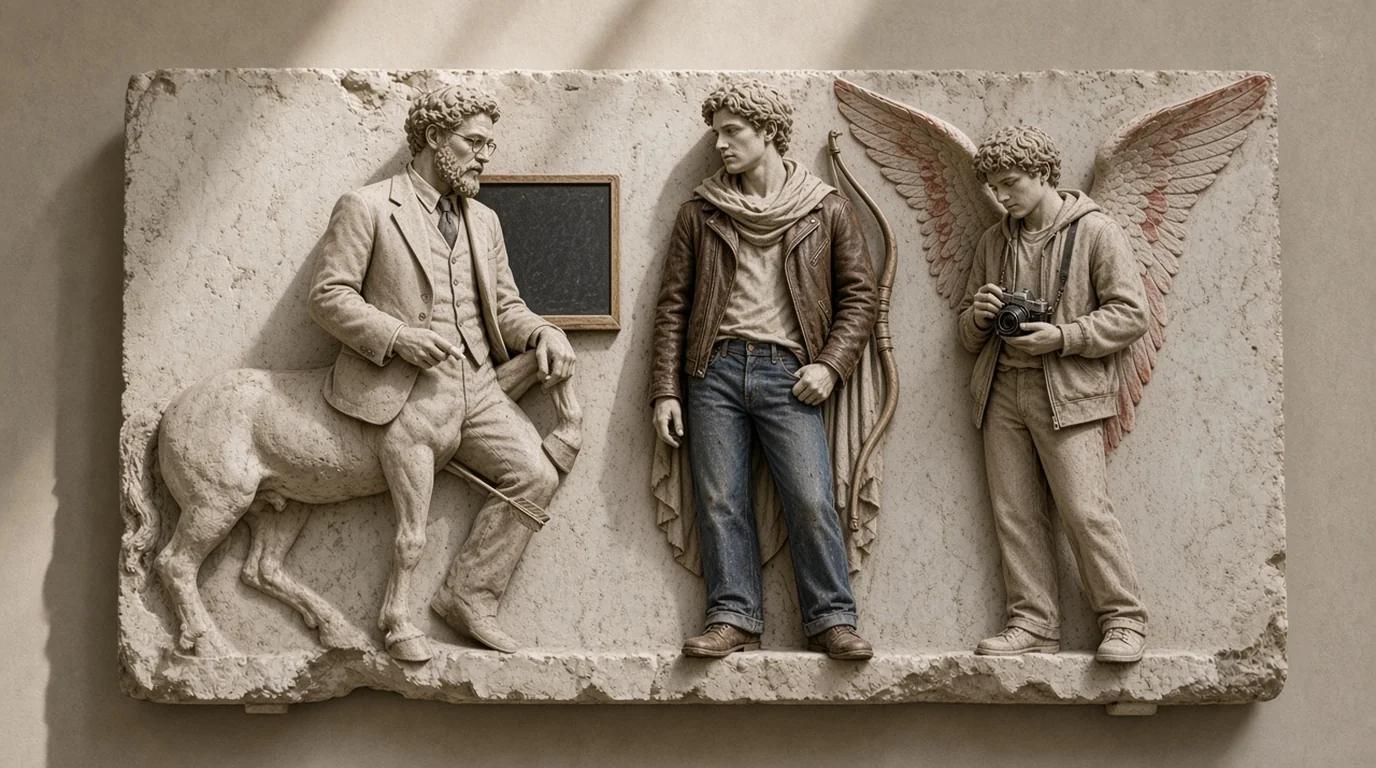
In a high-school classroom in Pennsylvania, on a January morning in 1947, a science teacher turns from the blackboard and feels an arrow strike his ankle. The class roars with laughter; he limps out into the corridor with the feathered shaft scraping the floor behind him. Decades later and far to the north, a small boy who is entirely red, with little red wings folded against his back, begins to write his autobiography, and the arrow that will one day find him has already been fired, in a poem composed in Sicily more than two and a half thousand years ago. The teacher is George Caldwell in John Updike’s The Centaur; the boy is Geryon in Anne Carson’s Autobiography of Red. Both are monsters out of Greek myth, and both were brought down by the same hero, with arrows dipped in the same poison.
Despite their striking mythological connections, the two novels are rarely discussed together, side by side, and at first glance they belong to different worlds: one a realist novel of small-town America by a writer at the start of a long career, the other a verse romance by a classicist and poet who in 2026 received the Nobel Prize, a prize that eluded the first writer. Yet they share a method and an obsession. Each takes a minor figure from the labors of Herakles, a creature half human and half something else, and sets him down in a modern landscape, to ask what it means to be wounded in a way that will not heal. Read together, they show two very different answers to a question that the retelling of Greek myth has always posed: whether the old stories are a costume we put on, or a truth we discover we have been living all along.
The myths behind the two books meet in a single weapon. When Herakles killed the Hydra, the many-headed serpent of Lerna, he dipped his arrows in its blood, and from then on every arrow he loosed carried a poison for which there was no cure. Two of the creatures it struck were Geryon and Chiron.
Geryon was the giant who lived on Erytheia, the red island at the western edge of the world, often placed near Cádiz, where he kept a herd of red cattle guarded by his herdsman Eurytion and the two-headed dog Orthos. He was the son of Chrysaor, whose name means “golden sword,” and the ocean nymph Callirhoe. The poets could not agree on his shape: Hesiod gave him three heads, the mythographer Apollodorus three bodies joined at the waist, and the Sicilian poet Stesichorus, in the sixth century BC, six hands, six feet, and wings. Stealing his cattle was the tenth of Herakles’ labors, and Stesichorus told the story from Geryon’s side, in a long poem, the Geryoneis, of which only scraps survive. In one of them, the arrow passes through Geryon’s head, and he bows his neck to one side like a poppy shedding its petals.
Chiron’s wound came earlier, during the fourth labor, the hunt for the Erymanthian boar. He was the gentlest and wisest of the centaurs, half man and half horse, immortal, the son of Kronos, and the teacher of heroes: Achilles, Asclepius, and Jason all learned from him. When a quarrel broke out between Herakles and the other centaurs, they fled to Chiron for refuge, and a stray arrow struck him, in the knee according to Apollodorus, in the foot according to Ovid. Being immortal, he could not die, and being poisoned, he could not heal. His release came through Prometheus, who lay chained to a rock for giving fire to mankind: Chiron agreed to surrender his immortality so that Prometheus might go free, and Zeus set him among the stars as the constellation of the Centaur.
So one monster dies in a single moment, struck through the head on a red island; the other lives on in endless pain until he chooses to give his life away. Carson took the first story and Updike the second, and each book is shaped by the nature of the wound it inherited.
Autobiography of Red, published in 1998 with the subtitle A Novel in Verse, is one of the strangest and most beautiful books of its decade, and its strangeness begins with its structure. The romance itself does not begin until the reader has passed through a sequence of scholarly antechambers. First comes an essay, “Red Meat: What Difference Did Stesichoros Make?”, which argues that the Sicilian poet’s great innovation lay in his adjectives, the words Homer had fastened to things and that Stesichorus unfastened, freeing his subjects from their fixed descriptions. Then come sixteen “fragments” of Stesichorus, which are not translations at all but playful, anachronistic reinventions, the first of which begins “Geryon was a monster everything about him was red.” Then three appendices on the legend that Stesichorus was struck blind for slandering Helen of Troy, and regained his sight only when he wrote a palinode, a poem of retraction, claiming she had never gone to Troy at all. The third appendix reasons its way, through a chain of numbered propositions, to a scene in which someone telephones Helen.
Only then does the romance begin: forty-seven short chapters in long, loose lines, telling the life of Geryon as a red, winged boy in an unnamed modern world that resembles Canada. The first wound comes early, and it is not Herakles who inflicts it. Geryon’s older brother walks him to school and then abandons him at the door, leaving the small boy to wait in the snow outside the kindergarten window until someone notices him. When a visiting grandmother is put in Geryon’s room, he is moved into his brother’s bunk bed, and the brother begins to abuse him at night, by turns bargaining and threatening. Carson tells it in a few spare pages and without commentary. The brother offers a prized marble in exchange, and “they developed an economy of sex / for cat’s-eyes”; when Geryon refuses, the brother threatens to tell their mother that nobody likes him at school. Afterward the brother’s voice turns kind, and the next day he takes Geryon swimming.
What Geryon does with this is the key to the whole book. Lying alone in his bunk afterward, he thinks about the difference between outside and inside, and decides: “Inside is mine.” That same day, Carson writes, he begins his autobiography, setting down all the inside things, his own heroism and early death, and coolly leaving out all the outside things. The autobiography is born as a refuge. At five, before he can write, it is a sculpture, a tomato with a cigarette glued to it and hair made of torn paper money; later it becomes a notebook of facts about a red monster killed by Herakles; later still a photographic essay, which, Carson tells us, Geryon works on from the age of five to the age of forty-four. The withdrawal that marks him all his life, the silences, the wings folded under his coat, the habit of watching rather than speaking, begins here, in a child who has learned that the only safe self is the one he represents himself. Even his mother, who loves him, sees only the sore he keeps picking at his lip, and tells him to leave it alone and let it heal.
At fourteen he meets Herakles, a sixteen-year-old with a car and a careless charm, and falls in love with him. The two boys paint graffiti, drive through the night, and travel to Herakles’ hometown, which is called Hades, where Herakles’ grandmother shows them a photograph of a volcano erupting in 1923. Then Herakles ends it, kindly, casually, and Geryon’s heart is broken in exactly the way a monster’s would be, and in the way of a boy who learned at night that closeness is a transaction: he has given himself entirely to someone who holds him lightly.
Years later, at twenty-two, Geryon is in Buenos Aires, and Herakles walks back into his life with a new lover, Ancash, a Peruvian who records the sounds of volcanoes. The three of them travel together through Peru, to Lima, to Huaraz, to the village of Jucu, in the shadow of a volcano. Ancash tells Geryon of a local legend, the Yazcol Yazcamac, people who were thrown into the volcano and came back out red and winged and immortal, eyewitnesses who had seen the inside of the fire. At dawn Geryon flies over the crater with Ancash’s tape recorder, to capture its sound for him. The romance ends at night, with the three men watching bakers in the village fire their bread in ovens dug into the volcano’s side. Geryon sees them as neighbors of fire, with immortality on their faces. After that comes one more section, an interview with Stesichorus, who answers his interviewer in riddles.
What Carson does with the myth is to complete Stesichorus’s experiment. The ancient poet was remarkable for telling the story from the monster’s side, so that Geryon, not Herakles, was the hero of the poem. Carson goes further and gives the monster the pen. The title is not decoration: this is Geryon’s own account, the inner life of a creature that the epic tradition saw only from outside, as an obstacle in the hero’s path. And in Carson’s version Herakles does not kill Geryon. He wounds him, which is worse, and leaves him to live with it. And he is not the first to wound him.
The Centaur, Updike’s third novel, appeared in 1963, between Rabbit, Run and the long line of books that would make him the great chronicler of postwar American life, and it won the National Book Award for Fiction the following year. It is set in Olinger, the fictional version of Shillington, Pennsylvania, where Updike grew up, over three days in January 1947. Its hero, George Caldwell, is a high-school science teacher modeled on Updike’s own father, Wesley, who taught at Shillington High; his son, Peter, fifteen, shy, afflicted with psoriasis, and in love with the paintings of Vermeer, is a portrait of the author as a boy.
The book opens in myth and reality at once. “Caldwell turned and as he turned his ankle received an arrow,” it begins, and for the next pages it is impossible to say whether we are in a Pennsylvania classroom or on the slopes of Mount Pelion. Caldwell is Chiron, and around him the citizens of Olinger shimmer with their divine counterparts. The principal, Zimmerman, is Zeus; the garage owner, Al Hummel, is Hephaestus, the smith of the gods, and his wife, Vera, the alluring gym teacher, is Venus; the town doctor is Apollo; Peter, the boy who will one day carry fire to the world as an artist, is Prometheus.
Beneath the mythology, the story is simple. Over three winter days, father and son drive to school and back in a failing 1936 Buick, which breaks down after a swim meet and leaves them stranded; a snowstorm traps them again; Caldwell, convinced that he has cancer, waits for the results of his X-rays with a dread he hides behind a stream of self-deprecating jokes. He is a clumsy, generous, exhausted man, who gives away everything he has, his money, his time, his dignity, to students who mock him and strangers who exploit him, and Peter, mortified and adoring, watches him do it. In the end the X-rays show no cancer, and Caldwell walks back into school accepting that his fate is simply to go on living and teaching, to go on giving himself away. The sacrifice of Chiron, in Updike’s version, is not a single act but a whole life.
The novel’s form is restless. Of its nine chapters, the even-numbered ones are told by Peter, now an adult painter in New York, looking back across fifteen years; the third is pure myth, Chiron teaching the young gods; the fifth is written in part as Caldwell’s obituary; the last returns to the borderland between centaur and teacher, and the book ends with a few untranslated lines of Greek from Apollodorus describing Chiron’s death and his placing among the stars. At the back is a “Mythological Index,” listing every god and nymph with the pages on which their human counterparts appear, which Updike added, according to Jonathan Miller’s notoriously hostile review, at his wife’s suggestion. The epigraph, from the Swiss theologian Karl Barth, sets out the book’s argument: “Heaven is the creation unconceivable to man, earth the creation conceivable to him,” and man a creature on the boundary between the two. Caldwell, half man and half beast, is that boundary made flesh.
The deepest thing the two books share is their choice of hero. Neither Carson nor Updike chose Herakles, the strong, simple, victorious figure at the center of the myths. Both chose his victims, and both chose hybrids: a boy who is human in every way except that he is red and has wings, a man who is human in every way except that he carries, in the mythic half of the book, the body of a horse. Each is marked as different in a way that cannot be hidden. Geryon’s wings must be folded under his coat; Caldwell’s ungainliness, his limp, his compulsive candor, make him a laughingstock in Olinger. Even Peter carries the mark, in the psoriasis he hides under long sleeves. These are books about the experience of being a monster in the eyes of others, and about the possibility that the monster’s view of the world is truer than the hero’s.
Both are also stories of wounds that do not close. Chiron’s wound is the purest image of chronic suffering in Greek myth: a pain that cannot kill because its victim cannot die. Updike translates it into the slow attrition of a man worn down by work, debt, and worry, a wound inflicted not by one arrow but by daily life. Carson’s Geryon carries two wounds, one inflicted in childhood by his brother and one in adolescence by Herakles, and the second reopens the first: the boy who learned in the dark that closeness means being used gives his heart to someone careless with it, and suffers the heartbreak a sensitive adolescent mistakes for the end of the world and that turns out, more painfully, to be survivable. Carson never states the connection, which is why it lands so hard. Neither book offers healing. What they offer instead is a way of living with the wound, Caldwell’s stubborn generosity, Geryon’s photographs, which hold still the moments that hurt.
And both stories are told by artists. Geryon is a photographer, and the late chapters of Carson’s book are titled as photographs, captions for pictures we cannot see; Peter Caldwell is a painter, telling his father’s story to the woman he lives with in New York, and wondering whether his art is worth the sacrifice his father made for it. For Geryon, making art began as self-protection: the autobiography he started the day after his brother’s first visit was a way of owning the inside when the outside belonged to someone else, and the camera completes the reversal, turning the boy who was looked at into the one who looks. Peter’s shame at the psoriasis he hides beneath his sleeves is the private beginning of a painter’s eye in the same way. In each book the act of making art is the act of turning a wound into a form, the old mythic labor of Prometheus, who stole fire from the gods and paid for it with his liver.
Where the books differ most is in the kind of love at their center. The Centaur is a novel about a father and a son, and its emotional force comes from the son’s slow realization of what his father gave up for him. The myth supports it exactly. Chiron gives up his immortality so that Prometheus can be free, and Caldwell gives up his life, in the slower, daily sense, so that Peter can escape Olinger and become a painter. It is a book of filial gratitude, written by a son barely thirty about a father still living, and it has the tenderness and the guilt of that position.
Autobiography of Red is a book about erotic love, and about the love that is not returned in equal measure. Herakles in Carson’s version is not a villain. He is simply a person who loves less than he is loved, which is the oldest wound in lyric poetry, and Geryon must learn to live in a world where the hero who broke his heart walks back into it with someone else. The book’s emotional climax is not a reconciliation but a flight, Geryon alone above the volcano, doing something for Ancash, the rival who has, against every expectation, become a friend.
Both books end by turning toward immortality, and in opposite directions. Updike’s closes with Chiron accepting death and being lifted into the sky as a constellation, the reward of a mortal sacrifice. Carson’s opens with an epigraph from Emily Dickinson, “The reticent volcano keeps / His never slumbering plan,” whose closing lines say that the only secret people keep is immortality, and it ends with Geryon looking at the village bakers in the volcano’s glow and seeing immortality on their faces. For Updike, immortality is what a good man gives away; for Carson, it is what an ordinary person might glimpse, for a moment, in the light of a fire.
Both books were criticized for the very scaffolding that holds their myths in place. Jonathan Miller complained that The Centaur sank under its freight of classical reference, and mocked the Mythological Index as a scorecard for the reader; some reviewers of Carson’s book found its essays and appendices pedantic, a classicist showing off. Both complaints miss the joke, and the point. The apparatus in each book is partly a game with the reader, a reminder that we are watching an old story being retold and asked to see two things at once. Updike’s index is almost comic in its thoroughness, as if to say that the parallels hardly matter; Carson’s appendices tease the scholarly pursuit of truth until it collapses into absurdity, with someone telephoning Helen.
What the scaffolding does, in both cases, is to keep the myth at a slight distance from the realist story, so that neither swallows the other. This is different from the way many recent retellings of Greek myth work. Novels like Madeline Miller’s Circe or Pat Barker’s The Silence of the Girls step inside the old stories and tell them again from within, giving voices to figures the tradition silenced. Carson and Updike do something closer to what T. S. Eliot, writing about Joyce’s Ulysses in 1923, called the mythical method: they lay the myth alongside modern life as a pattern, and let the two illuminate each other. Neither Geryon nor Caldwell ever quite becomes a figure of antiquity; they remain a boy in Canada and a teacher in Pennsylvania, who happen to be living out stories that are three thousand years old. That is the source of both books’ peculiar power, and why they belong at the start of any serious reading of the books that retell the Greek myths.
The Centaur has never been as widely read as the Rabbit novels, and it is easy to see why: its mythology can feel like a puzzle, and its Pennsylvania of 1947 is a long way from most readers today. But at its heart is a portrait of a kind of goodness that literature rarely attempts, the unglamorous, self-wasting goodness of a man who spends his life teaching children who do not want to learn, and gives away more than he can afford. Updike’s father appears again and again in his fiction, but never more lovingly than here, and the National Book Award it won in 1964 honored a book of real feeling under its classical disguise.
Autobiography of Red, by contrast, has grown in reputation every year since it appeared, and the Nobel Prize awarded to Carson in October 2026, for an oeuvre in playful dialogue with the classical tradition, has brought it new readers; our guide to Anne Carson’s books places it within her work, and its sequel, Red Doc>, published in 2013, follows Geryon, now called simply G, into adulthood. Its portrait of a childhood abuse survived in silence, of adolescent love and heartbreak, of a queer boy who feels himself a monster and discovers that he is not, has made it a beloved book for readers who never open a classical text, and its form, half essay and half romance, half scholarship and half lyric, opened a door for a generation of writers who no longer believed the genres had to be kept apart. Both books stand alongside the laureates and prizewinners gathered in our guides to the National Book Award winners and the Nobel Prize in Literature winners.
Geryon at the end of his romance, carrying the wounds of his childhood and of his first love, stands in the dark beside a volcano, watching men bake bread in the mountain’s fire, and Caldwell at the end of his walks back into a school on a winter morning, carrying the wound that will not heal. One was killed in the old story by an arrow through the head; the other was granted, in exchange for his suffering, a place among the stars. Their modern versions receive neither death nor apotheosis. They go on living, which is the hardest ending either myth could have been given, and both writers seem to understand that it is also the truest. The arrows of Herakles are still in flight, in these books and in every life where a wound is carried quietly and something is made from it: a photograph, a painting, a lesson taught to children who are not listening, a loaf of bread pulled from the side of a volcano.