
Newsletter Subscribe
Enter your email address below and subscribe to our newsletter


This content may contain affiliate links. When you buy through these links, we may earn an affiliate commission.
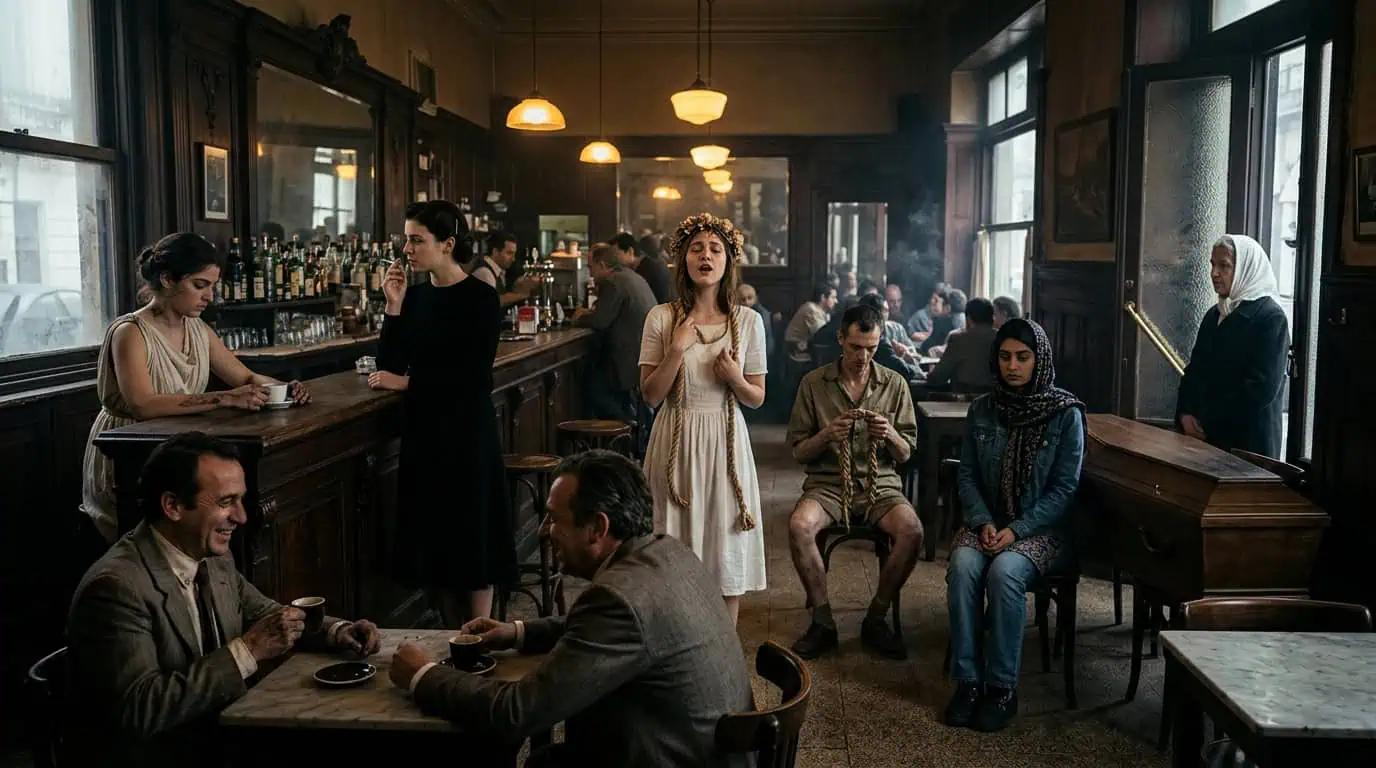
A young woman in a white dress and a withered crown of flowers hangs from a rope. Then she takes the rope from her neck, steps down, and begins to sing. Two men at a café table nearby, drinking their coffee in a city that has just come through a dictatorship, watch her with amusement and make jokes at her expense. This is the opening of Griselda Gambaro’s Antígona furiosa, first performed in Buenos Aires in September 1986, three years after the generals left power, and it is a perfect emblem of the play it rewrites. Sophocles’ Antigone died in her tomb more than two thousand four hundred years ago. She has been climbing out of it ever since.
The war at Troy has been retold more often, but no Greek story has travelled so far, or been turned so pointedly against so many governments, as the story of the young woman who buried her brother against the king’s command. She has been staged in occupied Paris and in the ruins of Berlin, imagined by a Spanish exile in the mountains of the Jura, rehearsed by prisoners on an island off Cape Town, and sent to sit beside a coffin in a park in Karachi. Each of these Antigones answers a particular regime, and read together they make a remarkable argument: that wherever a state claims the right to decide who may be mourned, Antigone appears. This essay follows her around the world, and asks what each new version saw in the old story that the others missed. It belongs with the other retellings gathered in our guide to Greek mythology books.
Sophocles’ play, first performed in Athens around 441 BC, begins after a civil war. The two sons of Oedipus, Eteocles and Polyneices, have killed each other at the gates of Thebes, one defending the city and one attacking it. Their uncle Creon, now king, decrees that Eteocles will be buried with honor and Polyneices left in the open for the dogs and birds. Antigone, their sister, asks her sister Ismene to help her bury him; Ismene, frightened, refuses. Antigone goes alone and sprinkles dust over the body. She is caught, brought before Creon, and defends herself by appealing to the unwritten laws of the gods, which no king can override. “I was born to join in love, not hate,” she tells him, in Robert Fagles’s translation. Creon’s son Haemon, who is to marry her, pleads for her life and fails. She is walled up alive in a cave. The prophet Tiresias warns Creon that the gods are offended, and Creon relents, too late: Antigone has hanged herself, Haemon kills himself over her body, and Creon’s wife kills herself when she hears.
The play has been read in a hundred ways. Hegel saw it as the collision of two equally justified powers, the family and the dead on one side, the state and the living on the other, each destroyed by its one-sidedness. Others have seen a simpler conflict between conscience and tyranny. But there is a strange detail at its center that has puzzled scholars for a century and a half: Antigone buries her brother twice. The first burial succeeds; the guards find the body covered with dust and do not know who did it. Then the guards uncover the body, and Antigone comes back, in daylight, to bury it again, and this time she is seen. The great editor Richard Jebb confessed he could not explain why. Theories abound: the gods performed the first burial, or Antigone returned to pour the libations, or, in the boldest modern reading, Ismene did it, and the sister who seemed to refuse was in fact the first to act. The simplest is that she wanted to be seen. A secret act of piety was not enough; the refusal had to be public. That is the Antigone who has traveled the world: not only the woman who buries the dead, but the woman who insists that everyone watch her do it.
It is worth pausing, before following her abroad, on how difficult Sophocles’ heroine is. She is not gentle. When Ismene, too late, asks to share her punishment, Antigone turns her away: “You chose to live, I chose to die.” From her first scene she speaks of death as a prize, “that death will be a glory,” and she tells Creon that to die before her time she counts “a gain.” Shortly before she is led away she offers an argument that has embarrassed her admirers for two centuries: a husband or a child could be replaced, but with her parents dead no other brother could ever be born. Goethe hoped a scholar would prove the lines spurious. Hegel, who admired her, still judged her one-sided, and Jacques Lacan, in his seminar on ethics of 1959 and 1960, saw in her a terrible splendor, a figure who has crossed the limit the living observe and who is drawn, in some sense, toward the other side. None of this cancels her courage. It means that the play gives us a heroine who is also an absolutist, whose refusal of every compromise includes the compromise of staying alive, and the retellings that matter most are the ones that notice.
Jean Anouilh’s Antigone opened at the Théâtre de l’Atelier in Paris in February 1944, with the city still under German occupation, in an unheated theater subject to power cuts. Anouilh’s wife, Monelle Valentin, played Antigone; Creon wore evening dress, and the guards wore black oilskin coats that reminded audiences of the Gestapo and the French Milice. The German censors had approved the script. A figure called the Prologue opened the play by introducing the actors and telling the audience exactly how it would end, and later a Chorus delivered a famous speech on the cleanliness of tragedy, in which there is no hope and therefore no anxiety.
Anouilh’s great change was to strip Antigone of her religion. His heroine buries her brother not because the gods command it but because she refuses to accept a world that asks her to compromise; her defiance is a pure, almost adolescent no, a refusal to grow up into the world of adults who say yes. And his Creon is the most persuasive in the long history of the play: a tired, intelligent man who explains, in a long scene at the center of the play, that someone has to rule, that ruling means dirty hands, that he left Polyneices unburied because the city needed an example and he does not even know which brother’s body is which. At the end, after Antigone and Haemon and his wife are dead, Creon goes off to a cabinet meeting, and the guards return to their game of cards.
The play’s politics have been argued over ever since. A collaborationist critic praised its ending as a return to order; others on the Resistance side heard complicity in Creon’s eloquence; after the Liberation, Creon was compared to Pétain, and André Breton called the play contemptible. Yet audiences in occupied Paris also heard in Antigone’s refusal the voice of resistance, and the play has lasted precisely because it holds both readings at once. That doubleness was also a risk, and Anouilh did not fully control it. His Creon is so reasonable, and his Antigone’s no so nearly wordless, that the play can be staged as a case for order without changing a line; the collaborationist praise was not simply a misreading. Anouilh’s Antigone does not win the argument. She simply refuses to have it, and that refusal, in a city where most people had learned to say yes, was itself a kind of answer.
Bertolt Brecht, returning to Europe from American exile, staged his own Antigone in February 1948, not in Germany but in the small Swiss town of Chur, with his wife, Helene Weigel, in the title role. He worked from the German translation made by the poet Friedrich Hölderlin in 1804, and he opened it with a new prologue set in Berlin in April 1945. Two sisters come up from an air-raid shelter and find their brother’s pack, with bread and bacon in it. Then they learn that he deserted from the army and has been hanged by the SS outside the door. Should they cut him down, under the eyes of the SS?
In Brecht’s version, Creon is a war leader who has attacked the neighboring city of Argos for its ore, and Polyneices is no longer a traitor who attacked Thebes but a deserter from Creon’s war of plunder. The play becomes an anatomy of fascism, of a leader who would rather see his city destroyed than surrender, and of the ordinary people who serve him until it is too late. Brecht was not interested in Antigone as a saint. He was interested in why so few people had acted like her, and his prologue asks the German audience of 1948 the question they least wanted to hear: what would you have done? Two decades later, Judith Malina’s English version of Brecht’s text, staged by the Living Theatre with no sets and no costumes, toured Europe through the upheavals of 1967 and 1968, and the deserter’s sisters became the voice of a generation’s protest against another war.
The Spanish philosopher María Zambrano left Spain in 1939, after the defeat of the Republic, and spent almost thirty years in exile, in Mexico, Puerto Rico, Cuba, Rome, and finally a house in the Jura mountains near the Swiss border. There, in 1967, she finished Antigone’s Tomb, her only play, which has only now, in 2025, been translated into English, by Clare Nimmo. It grew from a private grief: her sister Araceli had been tortured by the Nazis, and Araceli’s husband had been handed over to Franco’s regime and shot. Zambrano saw her sister in Antigone, and as early as 1948 she had written that Antigone is buried alive in all of us.
Her play begins from a bold correction of Sophocles. Antigone, Zambrano insisted, could not have hanged herself; she had too much still to understand. So in Antigone’s Tomb she lives on in the cave, in a long delirium of memory, and the figures of her life come to visit her one by one: her sister Ismene in a dream, her blind father Oedipus, the nurse Ana who raised her, the shadow of her mother Jocasta, her two dead brothers, Haemon, and finally Creon. “Sí, yo sé que todas las victorias se alzan sobre el llanto,” she tells her brothers: yes, I know that all victories are raised upon weeping. Zambrano’s Antigone is not a rebel but a witness, the conscience of every civil war, trapped between the living and the dead. She is the figure of exile itself, a person condemned to live in a place that is neither home nor the grave, and she gives Sophocles’ story its most philosophical form.
In July 1973, in a small theater in Cape Town called The Space, two actors, John Kani and Winston Ntshona, performed a play they had created with Athol Fugard, under a deliberately misleading title to avoid the censors’ attention to prison plays. It was soon renamed The Island. Its two characters, John and Winston, share a cell on an unnamed island that every South African recognized as Robben Island, where Nelson Mandela and other political prisoners were held. They spend their days in pointless labor, filling buckets with sand and emptying them; at night John makes an imaginary telephone call home to New Brighton with a tin mug. And they rehearse a play for the prison concert: Antigone, with John as Creon and Winston, protesting at having to wear a wig made of rope and false breasts, as Antigone.
The play’s origins were real. The Serpent Players, the black theater group in New Brighton to which Kani and Ntshona belonged, had planned an Antigone in 1965, and one of its members, arrested and sent to Robben Island, reportedly performed it for the prisoners there. Mandela himself, it turned out, had played Creon in a production by the island’s amateur drama society, and he wrote about it two decades later in Long Walk to Freedom. Creon, he concluded, was sincere and patriotic but merciless, and a leader must temper justice with mercy. “It was Antigone who symbolized our struggle,” he wrote.
The final scene of The Island is the performance itself. Winston, sentenced like Antigone, tears off the wig and speaks her last lines as his own: “Time waits no longer. I go now to my living death.” Then the siren sounds, and the two men are shackled and run back to their labor. The Island opened in London at the Royal Court at the end of 1973, and on Broadway the following year, and Kani and Ntshona shared the Tony Award for Best Actor in 1975. No version of Antigone has made the old story so physical, or shown so clearly that the play is not a museum piece but an instrument, something prisoners could use to tell the truth about their condition in a language their jailers would not think to censor.
In Latin America, Antigone became the figure of the disappeared: the tens of thousands of people abducted and killed by military regimes, whose bodies were never returned to their families. Gambaro’s Antígona furiosa came out of Argentina’s Dirty War of 1976 to 1983, which had driven the playwright herself into exile in 1977 after the regime banned one of her novels. Her Antigone, already hanged when the play begins, replays her story for two men in a café, Corifeo and Antinoo, who mock her as a madwoman; Corifeo becomes Creon by climbing into a hard shell, the carapace of power. Scholars have read her as an image of the Mothers of the Plaza de Mayo, the women who marched every week demanding to know what had become of their children, and whom the regime dismissed as “the madwomen.” When Creon offers his pardon, this Antigone refuses it, insists that she will still bury her brother, and dies in fury. Gambaro, who renewed the Argentine theater over six decades, died in Buenos Aires in September 2026, at ninety-eight.
The Peruvian poet José Watanabe wrote his Antígona in 2000 for a single actress, Teresa Ralli of the theater group Yuyachkani, who plays every role with a chair as her only prop. Peru was emerging from twenty years of war between the Shining Path guerrillas and the state, in which tens of thousands died and many disappeared; a truth commission, created a few months later, would put the toll at nearly seventy thousand. Watanabe’s great discovery was Ismene. The narrator of his play, who tells the whole story in memory, is revealed at the end to be the sister who did not act, the one who stayed safe while Antigone buried their brother. “Today is the first day of the peace,” the play begins, in Cristina Pérez Díaz’s translation, and Ismene’s peace is haunted by her own cowardice. In the end she resolves to perform the rites she once refused. For a country in which most people had survived by keeping their heads down, Watanabe’s Ismene was a more honest mirror than any heroine.
Gabriel García Márquez, a Nobel laureate to be, had already found Antigone in Colombia. His first novel, Leaf Storm (1955), opens with an epigraph from Sophocles about Creon’s edict and moves the story to Macondo, the town he would later make famous. A doctor who lived there for years, and who once refused to treat wounded men brought to his door during one of the country’s civil wars, has hanged himself, and the town wants his body left to rot. An old colonel, bound by a promise, insists on burying him. The novel is told in three alternating monologues, the colonel’s, his daughter Isabel’s, and her young son’s, as they keep watch beside the coffin, and the Antigone it finds is a strange one: an old man, a pariah’s corpse, a burial carried out not for love but to keep a promise against a whole community. García Márquez shows how far the story can be stretched and still hold its shape. The duty to bury does not depend on the dead being lovable.
The most widely read Antigone of the twenty-first century is Kamila Shamsie’s Home Fire (2017), which won the Women’s Prize for Fiction in 2018. Its Polyneices is Parvaiz Pasha, a young British Muslim from London who goes to Raqqa to learn about the jihadist father he never knew, becomes disillusioned, and is shot dead outside the British consulate in Istanbul as he tries to come home. Its Creon is Karamat Lone, the Home Secretary, a politician of Pakistani origin who has built his career by distancing himself from his Muslim background, and who strips Parvaiz of his British citizenship and sends the body to Pakistan. Its Antigone is Parvaiz’s twin sister, Aneeka, who sits beside the coffin in a park in Karachi, before the cameras, demanding that her brother be buried at home. Its Haemon is Lone’s son, Eamonn, who loves her.
Shamsie has said that as soon as she began reading Antigone, the contemporary echoes were clear. Her novel takes the burial law and turns it into the law of citizenship, the power of a democratic state to decide who belongs to it and who may be cast out, even in death. It also restores the sister who refused: the book opens with Isma, the elder sister who raised the twins and who, like Ismene, chose caution. And it ends, like Sophocles, in catastrophe, with Aneeka and Eamonn in a final embrace. That ending is the novel’s boldest stroke and its least secure. It arrives with a suddenness that some readers find overwhelming and others unearned, as if the novel, having built its London and its Karachi with such care, had handed its last pages back to the myth.
Shamsie took her epigraph from Seamus Heaney’s version, The Burial at Thebes, written for the centenary of Dublin’s Abbey Theatre in 2004, in which Heaney heard in Creon’s rhetoric the voice of a president preparing war in Iraq, telling the world that whoever is not with us is against us. Briefer sightings show how far she still travels. In 2012 Anne Carson published Antigonick, a fierce, funny version with drawings by Bianca Stone, discussed in our guide to Anne Carson’s books. And the old story keeps finding new cities. Sophie Deraspe’s film Antigone (2019) set it among a refugee family from Kabylia in Montreal, where one brother is shot dead by police and the other, jailed, faces deportation; this Antigone, still a minor, swaps clothes with him during a prison visit and takes his place in his cell. The burial has become a substitution, and the body she offers the state is her own. Bryan Doerries’s Antigone in Ferguson (2016) gathered police officers, activists, and young people in a Missouri town after the killing of Michael Brown to read the play together.
Set side by side, these Antigones reveal something the original contains but does not insist on. Sophocles’ play is about a burial, but its real subject is mourning: who has the right to grieve, and in public, for whom. Every regime that produced the Antigones gathered here was a regime that controlled mourning. The occupiers of Paris and the Nazis in Berlin decided which dead were heroes and which traitors; apartheid South Africa decided which prisoners could be visited; the Argentine and Peruvian militaries made their victims disappear so that there would be no bodies to bury; a British Home Secretary sends a body to another country so that it cannot be mourned at home. Antigone appears wherever the state claims the dead as its property, and her act, burying a body, is always the same act: a refusal to let power decide whose life was grievable.
That word belongs to the philosopher Judith Butler, who in Precarious Life (2004), written after the attacks of September 2001, asked whose lives a culture counts as worth mourning and whose deaths it renders invisible. Her earlier Antigone’s Claim (2000) had read the heroine as a figure who unsettles the family itself, the daughter of an incestuous line whose love for her brother no settled law of kinship quite allows. The retellings gathered here could serve as Butler’s case studies. But the political theorist Bonnie Honig has warned that this reading costs Antigone something too. In Antigone, Interrupted (2013) she argues that to see Antigone only as a mourner, a figure of lament raised above politics, is to miss the conspirator, the woman who plots and acts and may have had her sister’s help. Honig’s most provocative suggestion is that Ismene performed the first burial, and that Antigone’s later scorn for her is a performance meant to save her life. Not every classicist accepts it. But the argument gives back to Antigone what the language of mourning tends to take away, which is a politics.
The retellings also show how the figures around her have changed. Creon has grown more persuasive with every century, from Anouilh’s tired administrator to Mandela’s patriot who lacked mercy to Shamsie’s minister who believes he is protecting the nation. And Ismene, the sister who did not act, has moved toward the center, though not steadily and not everywhere. Anouilh keeps her to a few scenes of pleading; Brecht’s play hardly needs her, although his prologue puts her question to the audience, which is why so few acted. Her real arrival comes late, and in a particular kind of place: Zambrano’s dreaming sister, imagined in an exile that outlasted a dictatorship; Watanabe’s guilty narrator, written in a country about to open a truth commission; Shamsie’s cautious Isma, who opens the novel even though her sister comes to dominate it. These are works written after the catastrophe, for societies asking not only who resisted but who looked away, and Honig’s reading of the first burial belongs to the same moment. Few of us are Antigones. Most people, under any regime, are Ismenes, who stay safe and tell themselves there was nothing to be done, and the modern retellings have learned to speak to them.
Honig’s political Antigone raises a question the retellings gathered so far tend to avoid: if Antigone is political, whose politics are they? Every version in this essay has set her against the state, and it is tempting to conclude that the story belongs by nature to the resistance. It does not. What Antigone defends is blood, family, the gods, and the ancestral law of burial, against a ruler who puts the needs of the city first, and that is, at root, a conservative position. The story has been claimed for order at least as readily as for revolt.
Charles Maurras, the founder of the royalist and nationalist Action Française, read it that way. For Maurras, as his biographer Stéphane Giocanti presents him, Antigone was the guardian of the city’s true order and Creon the one who disturbed it, and to make her a modern rebel, an anarchist or a leftist, was to misread the play entirely. In Germany the play was staged often under the Third Reich, and scholars have traced how Hölderlin’s translation, the one Brecht would later reclaim, was enlisted for nationalist ends. Even Anouilh’s Antigone, as we have seen, found admirers among the collaborators.
From the liberal center came a different challenge. In October 1968, days after police broke up a civil rights march in Derry, the Irish writer and politician Conor Cruise O’Brien used the play in the Listener to think about the conflict he saw coming, and his sympathy lay less with the girl who would not yield than with the world her refusal would cost. “Without Antigone,” he concluded, “we could attain a quieter, more realistic world.” It was a deliberately unromantic reading: Antigone as the principled absolutist whose act sets off a chain of deaths, and the sister who gives way as the voice of a peace that someone must make possible. Seamus Heaney read the piece when it appeared, in the same issue of the magazine that carried his own article on the Derry march, and the question it raised stayed with him for decades.
The fullest map of all this is George Steiner’s Antigones (1984), which follows the story through two centuries of European thought and shows each age remaking her in its own image. The lesson applies here too. An essay that follows Antigone only through the resistance is following one of her lives, the one modern readers like best. She has others, and anyone who admires her should know them.
There is a harder lesson in the retellings, and it concerns the price. Sophocles’ Antigone can resist only by dying; her refusal of the king’s law is also a refusal of life, and she goes to it with something close to gladness. The versions that cut deepest are those that will not accept the bargain. Zambrano would not let her hang herself, and kept her alive in the tomb so that she could understand. Watanabe gave the story to the sister who lived, and let her act at last without a martyrdom. Fugard’s prisoners perform her death and then go back, shackled, to their labor, alive and still resisting the next morning. Deraspe’s Antigone walks out of her cell and has to decide whether to stay in the country that jailed her. Each asks whether resistance must always end in the cave, or whether there is a way of refusing the king that leaves the one who refuses alive.
Gambaro’s Antigone, at the opening of her play, takes the rope from her neck and sings, while two men drink their coffee and laugh. It is the most exact image of the story’s afterlife, and it cuts two ways. A woman who should be dead refuses to stay dead, and is mocked by the comfortable for the noise she makes; but the song comes from a woman who has already hanged herself, and by the end of the play she has chosen death again. Sophocles ended her story in a cave. The writers who followed have kept reopening it, in Paris and Berlin, in the Jura and on Robben Island, in Buenos Aires and Lima and Karachi, because the question she asked has never been settled, and the best of them have added a second question she did not ask: whether the price of refusal must always be a life. As long as there are bodies that power will not return, someone will take the rope from her neck. The harder hope, which the retellings at their best have dared, is that one day she will not need to put it back.