
Newsletter Subscribe
Enter your email address below and subscribe to our newsletter


This content may contain affiliate links. When you buy through these links, we may earn an affiliate commission.
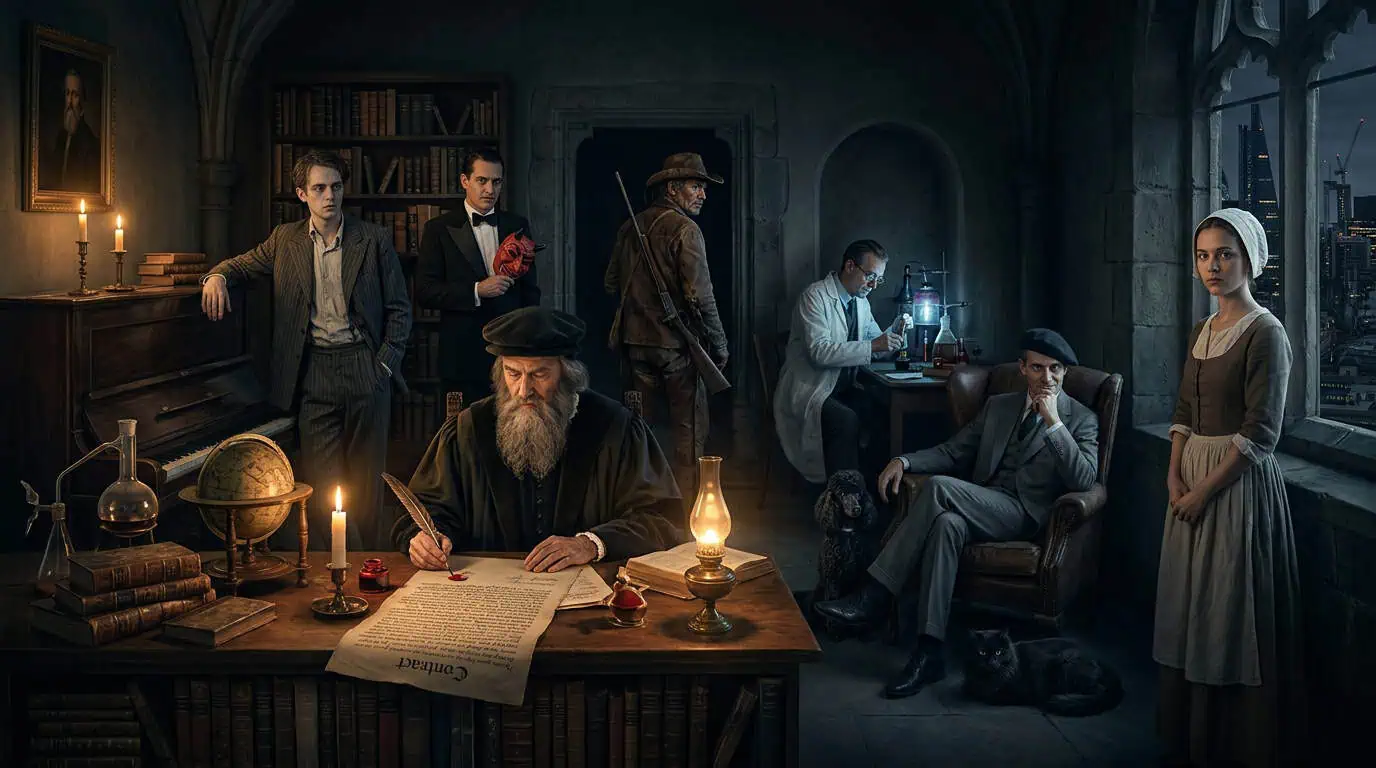
An old scholar sits alone in his study on Easter night, a stray black poodle curled by the stove, and opens the Gospel of John to translate it into his own German. He stops at the first line. “In the beginning was the Word” will not do; he tries “Mind,” then “Power,” and at last, satisfied, he writes, in Bayard Taylor’s translation, “‘In the Beginning was the Act.'” A moment later the poodle begins to swell, and out of the smoke steps Mephistopheles. This is the scene in Goethe’s Faust where the modern world announces itself: a man who has read everything and believes in nothing rewrites the first sentence of Scripture so that it begins with doing, and the devil appears to help him do it.
No story has been made to carry so much of what the modern West thinks about itself. Faust has stood for the scientist who goes too far, the artist who trades his humanity for genius, the developer who drains the marshes and burns down the cottage in the way, the official who serves a tyrant for the sake of his career, and the whole restless civilization that Oswald Spengler named “Faustian.” The phrase “Faustian bargain” has passed into everyday speech for any deal in which present power is bought with a price paid later. And the story has traveled, though not as widely as one might expect: to Moscow and Buenos Aires, to the Brazilian backlands and a Prague research institute, to a Tokyo manga studio and a Beijing stage. This essay follows the books that retold it, and asks what each new version saw in the old bargain. It also asks a question the Faust tradition tends to forget, which is who pays. It is a companion to our essay on Antigone around the world, the other great story that every age has retold for itself.
There was a real Faust, or at least a real man behind the name: Johann Georg Faust, an itinerant astrologer, alchemist, and magician who wandered the German lands in the early sixteenth century and died around 1540. The learned abbot Trithemius, writing in 1507, dismissed him as a fraud and a braggart, and legend says he died in an explosion during an experiment at an inn in Staufen, his body so mangled that people concluded the devil had come to collect. Within half a century the rumors had become a book. The Historia von D. Johann Fausten, printed anonymously by Johann Spies in Frankfurt in 1587, told the cautionary tale of a doctor who sold his soul for twenty-four years of knowledge and pleasure and was torn apart when the term ran out. An English translation followed in 1592, and it fell into the hands of Christopher Marlowe.
Marlowe’s Doctor Faustus, written around 1592 and performed through the 1590s, is the first great Faust and still one of the most frightening. His Faustus is a brilliant scholar bored by every discipline he has mastered, who conjures Mephistopheles and signs the pact in his own blood for twenty-four years of power. He then spends them, to the horror of anyone who has wanted much, on conjuring tricks, practical jokes on the Pope, and grapes out of season for a duchess. His most famous moment is an act of desire for a phantom: when the devils summon Helen of Troy, he greets her with “Was this the face that launched a thousand ships” and asks her kiss to make him immortal. The kiss is a demon’s. In the last hour he begs the clock to stop, and the devils take him. Marlowe’s version is Christian and pitiless, and its real horror is not damnation but waste: a man who could have had anything and could think of nothing worth having.
Goethe worked on Faust for most of his life, from the early drafts of the 1770s, through Part One in 1808, to Part Two, finished in 1831 and published after his death in 1832. He transformed the story at its root. His Faust is not a conjuror who sells his soul for pleasure but a scholar whose hunger has no object, a man in whom, in Walter Kaufmann’s translation, “Two souls, alas, are dwelling in my breast,” one clinging to the world, the other straining away from it. And the pact becomes a wager. Faust bets Mephistopheles that the devil can never give him a moment so satisfying that he would ask it to stay, “Verweile doch! du bist so schön!”, linger awhile, you are so beautiful. If he ever says it, his soul is forfeit. Above them, in a prologue in heaven, God has made his own wager with the devil: that a man who strives, however wildly, will not be lost.
The modern meaning of Faust lies in that change. Striving itself, restless and never satisfied, becomes the measure of the man, and the devil’s job is to keep it moving. Mephistopheles describes himself, in Taylor’s version, as the power “Which always wills the Bad, and always works the Good,” and he serves Faust’s ambition better than any angel could.
But the first part of the drama is not about ambition at all. It is about Gretchen, a girl of fifteen whom Faust seduces with Mephistopheles’ help, and whose life the bargain consumes. Her mother dies of the sleeping draught Faust gave her to quiet; her brother is killed by Faust in a duel; she drowns the child she bore him and is condemned to death. When Faust comes to free her from prison, with Mephistopheles’ horses waiting at the door, she refuses to go. “Judgment of God! myself to thee I give,” she cries, in Taylor’s version, and as Mephistopheles declares her judged, a voice from above answers that she is saved. It is easy, reading the tradition, to remember Faust’s striving and forget that its first and most perfect victim is a young woman who never asked for any of it.
Goethe, though, does not leave her as a victim, and his treatment of her is the strongest counterweight to the argument this essay is making. Gretchen’s refusal is the one act in Part One that the devil cannot bend. Faust has bargained, schemed, and fled; she, half mad with grief and condemned to die, chooses judgment over rescue, and the choice is what saves her. Her salvation is her own, won by refusing a second bargain with the powers that ruined her. And at the very end of Part Two, when angels carry Faust’s soul upward, she returns among the penitent women, identified in the text as the one once called Gretchen, and asks to be allowed to teach him the way, since he is still dazzled by the new light. The poem’s last words belong to a mystical chorus: “Das Ewig-Weibliche / Zieht uns hinan,” the eternal feminine draws us on. Readers have never agreed on what to make of it. One reading finds here the deepest generosity in the poem, the wronged girl turned into an agent of grace. Another finds the tradition’s blind spot in its most exalted form, the victim enlisted in the redemption of the man who destroyed her, her suffering made the price of his salvation as well as her own. Goethe holds both, and a reader should too.
Part Two widens the bargain to the scale of a civilization. Mephistopheles rescues a bankrupt Emperor by inventing paper money. Faust summons Helen of Troy and has a son by her. And at last, in old age, he becomes a developer, reclaiming land from the sea with dikes and canals to build a new country of free people on free ground. One obstacle remains: an old couple, Philemon and Baucis, whose cottage and chapel stand in the way. Faust wants them moved; Mephistopheles and his men burn the house down with the old people inside. Blinded by Care, Faust hears the sound of spades and believes it is his great canal; it is the lemures digging his grave. Imagining the free people on the land he has made, he says that to such a moment he could say “Linger awhile,” and dies. The devil seems to have won the wager. Angels carry Faust’s soul away instead.
The critic Marshall Berman, in All That Is Solid Melts into Air (1982), called Goethe’s Faust “the first, and still the best, tragedy of development,” and the phrase has rightly stuck. Faust the developer is the hero of modernity and its first casualty report: the man who builds the future and sweeps away the people who were living in the present. Goethe saved him at the end, and readers have argued ever since about whether the poet meant the salvation, or whether he meant us to see how much it costs.
By the time Goethe died, Faust had become less a character than a type, and the type has had a strange career. In The Decline of the West (1918), Oswald Spengler gave the name “Faustian” to the whole of Western civilization since the Middle Ages, a culture of infinite striving, of distance and the will to power, which he contrasted with the “Apollonian” culture of the ancient world. In his hands the word was half a boast and half an obituary. In everyday speech it has settled into something plainer. A Faustian bargain is a deal in which a person trades something of lasting value, conscience, health, love, independence, for knowledge, power, or success now, with the price falling due later, usually at the worst possible moment.
The phrase is used so often that its double edge is easy to miss. Goethe’s own story does not condemn the bargain outright; it is ambivalent about whether striving that destroys others can still be redeemed. The retellings divide along that line. Some take the side of the strivers, some take the side of Gretchen and the old couple in the cottage, and the best of them, like Goethe himself, refuse to choose.
Russian writers took Goethe’s Faust early and turned him in their own directions. Alexander Pushkin’s “Scene from Faust” (1825) finds Faust by the sea, sunk in boredom, the one torment Mephistopheles cannot cure, and it ends with Faust, for want of anything better to do, ordering a ship to be sunk. Ivan Turgenev’s novella Faust (1856), told in letters, is about a man who reads Goethe’s poem aloud to a married woman whose mother had kept her from poetry all her life, and the reading awakens a passion that destroys her. Both turn the Faust story into a study of the Russian intelligentsia’s restlessness, and both, like Goethe, count the cost in a woman’s life.
The great Russian Faust, though, is Mikhail Bulgakov’s The Master and Margarita, written between 1928 and 1940 and published, heavily cut, only in 1966 and 1967. It opens with an epigraph from Goethe, in Richard Pevear and Larissa Volokhonsky’s version, “I am part of that power which eternally wills evil and eternally works good,” and the devil who arrives in Stalin’s Moscow, Professor Woland, takes his name from one of Mephistopheles’ aliases in Goethe’s poem. Bulgakov turns the bargain inside out. In a city where the state has abolished God, the devil is the only figure who keeps his word, punishes the cowardly bureaucrats and informers who run Soviet literary life, and recognizes the genius that the state has crushed. Margarita, whose name recalls Gretchen’s Margarete, is no victim: she makes her own pact with Woland, serves as hostess at his midnight ball to save the man she loves, and spends the single wish he grants her on mercy for Frieda, a woman tormented for smothering her own child, a figure who carries Gretchen’s crime into Bulgakov’s book. Our essay on The Master and Margarita follows the novel in full; here what matters is the reversal. Under Stalin, the bargain with the devil became the only honest contract in town.
The largest of the retellings came from a German in exile. Thomas Mann began Doctor Faustus in Los Angeles in 1943 and published it in 1947, and he meant it as nothing less than the Faust of his nation. Its hero, Adrian Leverkühn, is a composer of cold, prodigious gifts who, as a young man, deliberately contracts syphilis from a prostitute he calls Esmeralda, and in a fever-dream conversation with the devil learns the terms: twenty-four years of radical genius, at the price of never being able to love. He invents a new system of music, writes works of terrifying originality, destroys everyone who comes close to him, and collapses into madness after confessing the pact to a gathering of bewildered friends.
The story is told by his friend Serenus Zeitblom, a decent, pedantic schoolmaster who writes it between 1943 and 1946 as Allied bombs fall on Germany, and the parallel is never allowed to rest. Leverkühn’s bargain is Germany’s: a culture of the highest refinement that sold its soul for a breakthrough, chose the cold intoxication of power over ordinary human warmth, and went mad. The novel’s last words are Zeitblom’s, in H. T. Lowe-Porter’s translation of 1948: “God be merciful to thy poor soul, my friend, my Fatherland!” The book carries its own controversies. Arnold Schoenberg, Mann’s neighbor in California, was furious to find his twelve-tone method given to a syphilitic composer in league with the devil, and later editions carry a note crediting him. The philosopher Theodor Adorno advised Mann on the music so extensively that he felt the book half his. It is a difficult novel, dense with musical and theological argument, and English readers have a choice between Lowe-Porter’s version and John E. Woods’s more exact one of 1997. It is also as searching an account as any novelist has given of how a great culture could make itself available to evil.
Thomas Mann’s son Klaus wrote a smaller and angrier Faust a decade earlier. Mephisto, published in exile by Querido in Amsterdam in 1936 and subtitled Novel of a Career, follows Hendrik Höfgen, a brilliant, insecure provincial actor who rises to the top of the German theater by making himself useful to the Nazis, and whose greatest role is Mephistopheles. Everyone knew who he was. Höfgen is a barely disguised portrait of Gustaf Gründgens, Klaus Mann’s former brother-in-law, who had played Mephisto on the Berlin stage and who ran the Prussian State Theater from 1934 under the protection of Hermann Göring. The bargain here is not with a supernatural devil but with a regime, and the price is not a soul in the theological sense but integrity, friends, the ability to look at oneself.
The novel’s afterlife became a lesson in the power of the people it portrayed. Gründgens survived the war and resumed his career, and after his death his adopted son sued to stop the book’s publication in West Germany. The courts agreed, and in 1971 the Federal Constitutional Court upheld the ban on a tied vote, weighing artistic freedom against the dignity of a dead man. The book appeared there only in 1981, when the publisher Rowohlt simply printed it and was not sued. That same year István Szabó’s Hungarian film, with Klaus Maria Brandauer as Höfgen, carried the story around the world and won the Academy Award for best foreign-language film. As a novel Mephisto is uneven, its portrait of Höfgen too plainly driven by personal grievance to be fair, and its satire sometimes heavy. As a study of the ordinary careerist who makes the devil’s bargain one small compromise at a time, it has rarely been bettered.
In Latin America, Faust arrived first as comedy. Estanislao del Campo’s Fausto (1866), one of the classics of Argentine gaucho poetry, is the account a gaucho named Anastasio el Pollo gives his friend, on a riverbank, of an evening at the opera in Buenos Aires, where he saw Gounod’s Faust and took every word of it for real. The joke is affectionate and double: the countryman’s innocence exposes the absurdity of the opera, and the opera’s grand passions are translated into the plain idiom of the pampas, where a pact with the devil is the kind of thing a sensible man would avoid. Argentines have loved the poem ever since: a European myth retold, misunderstood, and quietly improved by a man who has never heard of Goethe.
The great Latin American Faust is something else entirely. João Guimarães Rosa’s Grande Sertão: Veredas (1956), a towering novel of Brazilian literature, is the monologue of Riobaldo, an old former gunman of the backlands, telling his life to a visitor from the city. At its center is a midnight at a crossroads called the Veredas-Mortas, where the young Riobaldo calls on the devil to give him the strength to destroy his enemy Hermógenes. Something happens. He becomes a leader, ruthless and successful, and he spends the rest of his life and the whole of the book unable to say whether the devil exists, whether the pact was made, or whether he simply found the devil in himself. Rosa’s Faust has no Mephistopheles at all, only the doubt, and the doubt is more frightening than any devil. The first English translation, The Devil to Pay in the Backlands (1963), by James L. Taylor and Harriet de Onís, is a famously inadequate rendering of a novel written in a language Rosa largely invented; a new translation by Alison Entrekin, Vastlands: The Crossing, is announced for January 2027.
Central Europe gave Faust a philosophy of history. Imre Madách’s The Tragedy of Man (1861), the classic of Hungarian drama, is a Faust-like poem in fifteen scenes in which Lucifer, the spirit of denial, leads Adam through the whole of human history, from Egypt and Athens through Rome, Byzantium, and the French Revolution to industrial London and a frozen end of the world, to show him that every ideal ends in failure. Adam despairs and is ready to throw himself from a cliff; God’s last word to him is to strive, and trust. The play has been staged in Budapest since 1883 and holds a place in Hungarian culture something like Goethe’s in German.
A century later, Václav Havel wrote the Faust of the Cold War. Temptation (1985), composed when Havel was a banned playwright under constant police surveillance, circulated in samizdat and premiered in Vienna in 1986. Its Faust is Dr. Foustka, a scientist at an institute devoted to the struggle against superstition, who secretly dabbles in magic, and its Mephistopheles is Fistula, a seedy, ingratiating little man with smelly feet who offers him occult knowledge. The twist is pure Havel. The institute’s director has known about Foustka’s experiments all along, and Fistula turns out to have been working for the institute, an informer rather than a devil. In a police state the devil does not need to be supernatural; he is the colleague who reports on you, and the bargain is the one every intellectual under the regime was invited to make. Jan Švankmajer’s film Faust (1994), made in Prague just after the fall of communism with puppets, clay, and a bewildered modern man who wanders into an old marionette theater, belongs to the same tradition of Czech Fausts who never quite know who is pulling the strings.
It is worth being honest about the limits of Faust’s travels. Antigone’s story has been retold on every continent, because every society has its dead and its rulers. Faust’s has traveled less, because its machinery, the soul, the pact, damnation and grace, belongs to the Christian imagination, and in many literatures the bargain with dark powers already had older forms of its own. Where Faust has gone beyond Europe and the Americas, he has usually gone as a figure of Western modernity itself, the scientist and the developer, examined from outside.
Osamu Tezuka, the father of Japanese manga and a physician by training, adapted Faust in 1950, early in his career, and came back to it at the very end. Neo Faust, serialized through 1988 and now available in English, opens with Professor Ichinoseki of a Tokyo university, who after fifty years of research has failed to discover the truth of the universe and is about to kill himself when a sorceress named Mephist interrupts him. Her price is the old one: his soul, forfeit on the day he is satisfied enough to ask time to stop. She sends him back to 1958 as a handsome young man with no memory of who he was. A wealthy industrialist adopts him, dies, and leaves him a fortune, and the scholar’s hunger to know becomes an heir’s ambition to make: he sets out to create living things for his own purposes. That shift is Tezuka’s argument. Goethe’s Faust wanted to understand what holds the world together; Tezuka’s, reborn into the years of Japan’s economic miracle, wants to manufacture life, and his instruments are money and laboratories rather than magic. The bargain has become the postwar boom, and the devil’s gift is capital. Tezuka was dying of stomach cancer as he drew it, and the story breaks off early in its second part, so that the last great Faust of the twentieth century ends in the middle of its own experiment.
In Beijing in 1994 the director Lin Zhaohua staged an experimental Faust in which Mephistopheles was played by a woman, the actress Lou Naiming, putting the tempter’s voice, for once, in the mouth of the sex the story usually sacrifices. In the Arab world, Ali Ahmad Bakathir’s New Faust and Tawfiq al-Hakim’s The Pact with the Devil took up the bargain as an allegory of the East’s encounter with Western knowledge, though neither is available in English. These versions show the story being tested for fit in places that had their own devils and their own ideas about ambition, and finding that the modern part of it, the scientist and the builder, traveled better than the theology.
The tradition has a blind spot as large as Gretchen. In almost every version, Faust strives and a woman pays: Gretchen and her child, Philemon’s wife Baucis, Turgenev’s Vera, the women in Leverkühn’s life whom the pact forbids him to love. Writers have pushed back. As early as 1841 the German novelist Ida Hahn-Hahn published Countess Faustine, the life of a restless, gifted woman who refuses to settle for any single love or vocation, the first attempt to give Faust’s hunger to a woman, though without the devil. In 1939 Dorothy L. Sayers wrote The Devil to Pay, a Faust play for the Canterbury Festival that brought the medieval Faust back to his Christian moral reckoning. And in 2012 the Austrian Nobel laureate Elfriede Jelinek wrote FaustIn and out, a “secondary drama” meant to be performed alongside Goethe’s early Urfaust and to talk back to it, turning the stage, at least for an evening, over to the women the story uses up.
Beyond Goethe’s own ending, Bulgakov’s Margarita, who makes her own bargain and spends its one reward on mercy for a child-murderer, remains the most generous answer the tradition has given to Gretchen. She is what Gretchen might have been if she had been allowed to strive.
Set side by side, these Fausts show the story splitting into three. There is the Faust of knowledge, the scientist who wants to know what should not be known: Marlowe’s scholar, Goethe’s alchemist, Havel’s Foustka. There is the Faust of creation, the artist or builder who pays for greatness with his humanity: Goethe’s developer, Mann’s composer. And there is the Faust of power, the man who serves the devil for the sake of a career or a state: Klaus Mann’s actor, Madách’s Adam on his tour of history, the bureaucrats Woland punishes. In the twentieth century the three merged in a figure the old legend could not have imagined, the physicist who builds the bomb. When San Francisco Opera commissioned John Adams’s Doctor Atomic (2005) about J. Robert Oppenheimer, it asked for an “American Faust”; Adams and his librettist Peter Sellars pointedly refused to make him one, as if the comparison had become too easy. The Russian director Aleksandr Sokurov went the other way, ending his four films about power, portraits of Hitler, Lenin, and Hirohito, with a Faust (2011) that won the Golden Lion at Venice, as if Goethe’s scholar were the root from which the dictators grew.
The retellings also show that Faust, like Antigone, belongs to no single politics. Spengler made the Faustian spirit a destiny to be embraced; Berman made it a tragedy to be understood; Thomas Mann made it a national catastrophe, Bulgakov a weapon against tyranny, Havel a mirror held up to the intellectual’s complicity. What the strongest versions share is a refusal to let Faust off, or to let us off by condemning him too easily. The bargain is not something done by monsters. It is offered to ordinary people every day, in laboratories and ministries and theaters, in exchange for things they genuinely want, and its price is nearly always paid by someone else.
Faust rewrote the first line of the Gospel in his study on Easter night, and the whole tradition has been living inside his correction. “In the Beginning was the Act”: it is the motto of every builder, inventor, and reformer who ever decided that thinking was not enough, and it is the sentence the devil was waiting for. The retellings gathered here have tested it in Moscow and Munich, in the backlands of Brazil and a Prague institute and a Beijing theater, and they have found it both true and terrible. Acts change the world, and someone always lives in the cottage that the act requires to be cleared. Goethe let the angels carry his striver to heaven and gave the girl he ruined the task of leading him there, which is either the poem’s highest mercy or its last injustice. The writers who followed him have mostly been less sure, and the best of them have turned, at the end, to look at Gretchen in her cell and the old couple in their burning house, and to ask the question Faust never stopped long enough to ask: what did the moment cost, and who paid for it?