
Newsletter Subscribe
Enter your email address below and subscribe to our newsletter


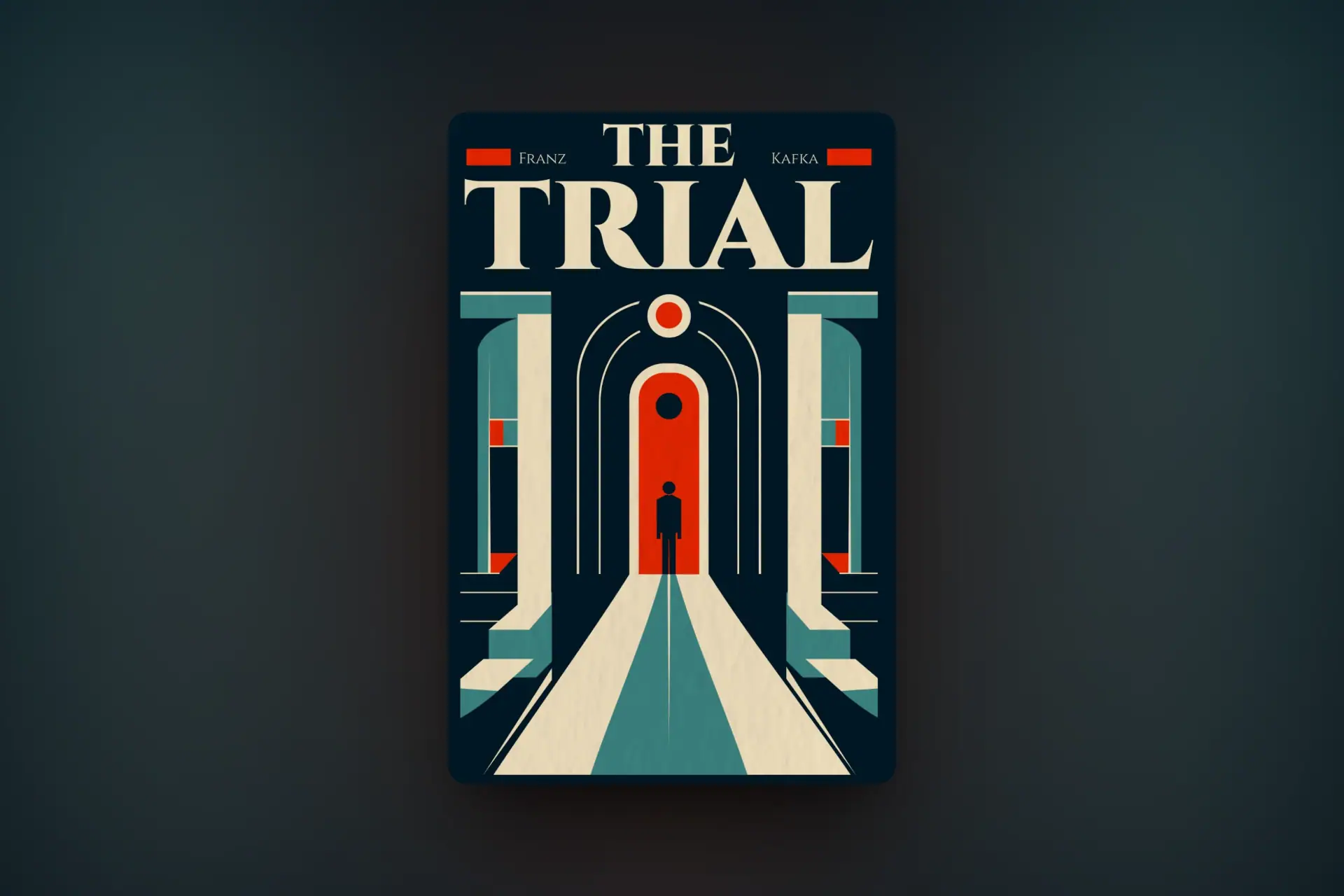
This content may contain affiliate links. When you buy through these links, we may earn an affiliate commission.
The horror of The Trial is not that a man is arrested one ordinary morning for a crime no one will name. It is that some part of him believes he deserves it. Josef K. never learns what he is charged with, never finds the court that judges him, never meets the authority that will finally put him to death, and yet he does not run. He argues, he petitions, he hires lawyers, he behaves at every turn like a man half convinced that the accusation, whatever it is, must somehow be just. The true subject of the novel is not the law at all. It is guilt, the strange conviction of guilt that seems to arrive before any crime and to require no evidence whatever.
Franz Kafka wrote the book in 1914 and 1915, on the eve of the catastrophe that would remake Europe, and then abandoned it unfinished. It was published only in 1925, a year after his death, by his friend Max Brod, who defied Kafka’s instruction to burn every page. What Brod saved became the defining vision of the modern individual crushed by a faceless power, and gave the language a word, kafkaesque, for a nightmare we have never stopped recognizing.
The Trial follows Josef K., a senior bank clerk who is arrested on the morning of his thirtieth birthday for a crime that is never named, and who spends the following year enmeshed in a remote and incomprehensible court before being executed on his thirty-first. He is arrested yet left free to go on working; he is tried yet never charged; he is drawn ever deeper into a system that offers endless process and no resolution.
There is almost no conventional plot, only a slow tightening. K. seeks out the court and cannot find it, hires an advocate who does nothing, consults a painter who explains that acquittal is effectively impossible, and is finally led away by two men in black to a quarry outside the city. Because Kafka left the book unfinished, its chapters were ordered after his death by Max Brod, which lends the novel its strange, dreamlike discontinuity, as though time itself had come loose. What holds it together is not story but a mounting pressure, the sense of a life quietly closing like a hand.
Camus located the absurd in the gap between our hunger for meaning and the silence of the world. Kafka finds something more intimate, and in the end more frightening. His accused man does not stand bewildered before an indifferent universe; he carries the tribunal within his own breast. The apparatus that pursues Josef K., the hidden judges, the endless offices, the warders who cannot say what he has done, is only the outward form of a sentence he has already half passed on himself. And because the charge is never named, it can never be answered, for a guilt without content is one that no innocence can disprove.
This is why he never simply walks away, though nothing at first prevents him. Offered his freedom on every ordinary day, he keeps returning to the court, keeps seeking out its officials, keeps behaving like a man who suspects that somewhere in the machinery there is a charge with his name on it that he cannot quite remember committing. As the trial spreads through his life he begins to scrutinize himself, to entertain the possibility that he really is guilty, and it is this creeping self-accusation, more than any executioner, that finally undoes him. The most modern thing about the book is its suggestion that the deepest authority is the one we install inside ourselves.
The world Kafka builds around this guilt is the most precisely realized nightmare in modern fiction. The court is not a marble hall of justice but a warren of shabby offices hidden in tenement attics, reached through the apartments of strangers, where laundry hangs drying beside the benches and the air is so close it makes petitioners faint. Its officials know nothing of the cases they administer. Hearings are scheduled without a stated time, so that a man can be told he is late for an appointment no one ever fixed. The proceedings can be dragged out forever but never won.
The system is not cruel so much as absurd, impersonal, and unanswerable, and that combination is exactly what makes it a nightmare. It was this machinery that gave the language the word kafkaesque, which describes an ordinary person trapped by an opaque, illogical system that cannot be reasoned with or escaped. The word has since taken on a life of its own, and its full meaning, its origin, and its misuse are worth an essay in themselves, which is why they have their own; here it is enough to feel the thing itself pressing on Josef K.
Kafka renders the court through a sequence of encounters, each a lesson in how the Law offers everything except a way out. At the first interrogation, K. delivers a defiant speech against the whole corrupt proceeding, only to learn that by walking out he has damaged a case whose rules he cannot discover. Days later he opens a storeroom in his own bank and finds the two warders who arrested him being flogged, punished because he complained of them, and when he returns the next evening the same scene is unfolding still, frozen and unchanging, as though the machinery has no memory and no mercy, only repetition.
His uncle, alarmed for the family name, drags him to the advocate Huld, a chronically ill lawyer attended by a young woman named Leni, who is drawn to accused men precisely because their guilt makes them beautiful to her. Huld talks endlessly and accomplishes nothing. The court painter Titorelli, who owes his living to the judges, lays out the three possible fates of an accused man with terrible clarity: definite acquittal, which no one has ever actually witnessed and which may be only a legend; apparent acquittal, which can be revoked at any moment; and indefinite postponement, which keeps the case forever alive at a low simmer. None of the three is freedom. And there is Block, a tradesman who has been Huld’s client for more than five years, reduced by his devotion to a cringing, dog-like creature who crawls before his lawyer, the living image of what total submission to the court makes of a man. Each figure shows K., and the reader, that the system dispenses process without end and judgment without appeal.
The novel’s meaning gathers itself into a single story near the end. Sent to show an Italian visitor around the cathedral, K. finds the man never arrives, and instead a priest calls him by name from the pulpit and tells him the parable of the Law. A man from the country comes seeking admittance to the Law and finds its door standing open, guarded by a single gatekeeper who tells him he cannot enter now, though perhaps later. So the man waits. He waits for years, bribing the gatekeeper, growing old, until at the very end of his life he asks why, in all this time, no one else has ever come to this door. The gatekeeper answers that no one else could be admitted here, because this entrance was meant for him alone, and now it will be shut.
Then the priest and K. argue about what the parable means, and Kafka refuses to settle it. Was the gatekeeper a deceiver or a faithful servant? Was the man a victim of the Law or the author of his own exclusion, since the door was open the whole time and he never dared to pass? Is the Law justice, or God, or grace, or meaning itself, forever available and never attained? The parable is the entire novel compressed to a point: an entrance that stands open and is never entered, a summons that cannot be answered. Its irresolution is not a flaw. It is the truth the book was written to deliver.
Kafka belongs, by common consent, to the literature of the absurd, and Camus claimed him for it directly, appending an essay on Kafka to The Myth of Sisyphus. Reading the two writers together is illuminating and uncomfortable, because they answer the same darkness so differently. Camus’s Sisyphus, condemned to a futile eternal labor, becomes an absurd hero by scorning his fate and, in scorning it, living; one must, Camus insists, imagine Sisyphus happy. Josef K. is condemned too, and he does the opposite. He assents. Led to the quarry, he offers no resistance, and dies with the word “Like a dog!”, feeling, as the last line has it, that the shame of it must outlive him.
That difference marks the far and darker edge of the same tradition. Where the philosophy of absurdism finds a strange freedom in a meaningless world, Kafka finds only the guilt and the closing door. Both belong to the same great conversation about how a person is to live without guarantees, the conversation mapped in our guide to the existentialist books to read after Camus, where The Trial stands as one of its most haunting landmarks.
Return, at the end, to the guilt that arrives before the crime, and to the door that was open all along. What lingers after the knife is not outrage at the injustice done to Josef K., because Kafka withholds even the certainty that an injustice was done. What lingers is a question the book presses quietly on the reader: how much of the machinery that torments us have we assembled ourselves, consented to, and dignified with the name of fate. The man from the country was never forbidden the Law. He was only afraid to enter, and the fear was enough. Kafka hands us that door, standing open, and declines to tell us whether we would have walked through it.