
Newsletter Subscribe
Enter your email address below and subscribe to our newsletter


This content may contain affiliate links. When you buy through these links, we may earn an affiliate commission.
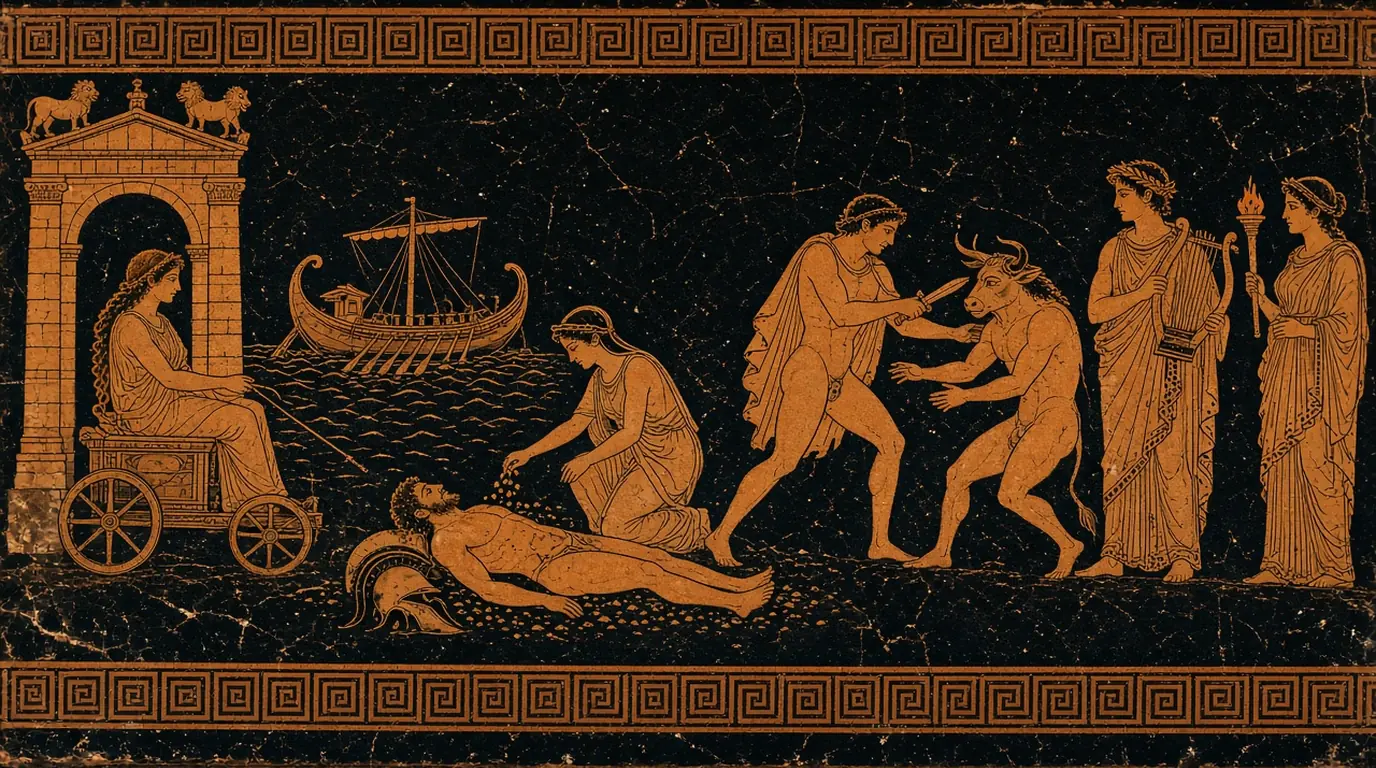
Outside the Lion Gate at Mycenae, a captive woman sits in a wagon and waits to be killed. She is Cassandra, the Trojan princess who saw the future and was never believed, and in Christa Wolf’s novel, written in East Germany in 1983 under the shadow of nuclear war, she spends her last hours remembering how her city talked itself into destruction long before the Greeks arrived. On a beach in St Lucia, two fishermen named Achille and Hector quarrel over a waitress named Helen. In a prison cell modeled on Robben Island, two men rehearse Antigone for the prison concert, and one of them, in a wig made of rope, prepares to tell the state that its laws are not the laws of the gods. Three thousand years after they were first told, the Greek stories are still being retold, in every language and on every continent, and the retellings are often as alive as the originals.
This guide is a reader’s map to the best Greek mythology books of a particular kind: the retellings, the novels, plays, and poems that take the old stories and make something new of them. It is arranged by the stories themselves, the fall of Troy, the long homecoming of Odysseus, Antigone, Oedipus, the house of Atreus, the Minotaur, Orpheus, and the monsters, and within each it sets the familiar English-language retellings beside the ones that most lists leave out: the German, French, Italian, Greek, and Albanian novelists, the Nigerian and South African playwrights, the Caribbean poet, the Argentines, the Egyptian dramatists, all of whom found in the Greek myths a way to speak about their own times. Many of them belong to the wider tradition traced in our guide to world literature, and most can be read in English.
The Greek myths survive not as a single book but as a scatter of versions: Homer’s epics, the tragedies of Aeschylus, Sophocles, and Euripides, the handbooks of later mythographers, the fragments of lost poems, and the Roman poet Ovid, who gathered many of them into his Metamorphoses. Even in antiquity no one told them the same way twice. Euripides rewrote what Aeschylus had written; Stesichorus told the story of the monster Herakles killed from the monster’s point of view. The myths were always arguments, and a retelling was always a reply.
That is why they have never stopped being retold. Each version leaves silences: the women of Troy who appear in Homer only as prizes, the monsters who have no voices, the dead who are refused burial, the children who pay for their parents’ crimes. Each age discovers a different silence and fills it. A German novelist under a Communist regime sees in Cassandra a woman who speaks the truth to a state that will not listen. A Nigerian playwright after a civil war sees in Oedipus a man who blames the gods for his own failings. An Argentine dramatist after the dictatorship sees in Antigone the mothers of the disappeared, demanding the bodies of their children. The stories are not costumes these writers wear; they are instruments for seeing what their own societies would rather not see.
No Greek story has been retold more often than the war at Troy, and the most important modern retelling of it may be one that many English readers have never heard of. Christa Wolf’s Cassandra (1983), translated by Jan van Heurck, gives the war to the prophetess whom no one believed, and it is unsparing about her own side: Troy in her telling is a city poisoned by propaganda and militarism long before the Greek ships appear. Published decades before the recent wave of feminist retellings, it remains the most searching of them all, a book about how societies drift into catastrophe with their eyes open.
The recent wave has its own triumphs. Pat Barker’s The Silence of the Girls (2018) tells the Iliad through Briseis, the captive whom Achilles and Agamemnon quarrel over, and makes the women’s camp, the laundry and the slave quarters, the real center of the war. Natalie Haynes’s A Thousand Ships (2019), shortlisted for the Women’s Prize, gives a chorus of voices to every woman the war touched, from Hecuba to Penelope to the goddess who started it all with a golden apple. Madeline Miller’s The Song of Achilles (2011) turns the war into a love story between Achilles and Patroclus, and its enormous readership has made it the most popular Greek retelling of the century.
Two Europeans approach the war from opposite directions. The Italian novelist Alessandro Baricco, in An Iliad (2004), translated by Ann Goldstein, takes the gods out of Homer entirely and lets twenty-one human witnesses tell the war in plain prose, a nurse, a river, a mother, Achilles, Hector; it is the most direct way into the Iliad for a reader who has never opened it. The French playwright Jean Giraudoux, in Tiger at the Gates (1935), sets his play on the eve of the war, as Hector and Ulysses negotiate to give Helen back and very nearly succeed. Written as Europe slid toward another war, it is a comedy about how wars happen even when no one wants them.
The Odyssey has inspired the most ambitious retelling in modern literature, Derek Walcott’s Omeros (1990), an epic poem that moves Homer to the island of St Lucia. Its fishermen are Achille and Hector; its Helen is a local woman; its Philoctete carries a wound that will not heal, which becomes the wound of slavery and colonialism; and a blind old man called Seven Seas stands in for the poet. Walcott, who received the Nobel Prize in 1992, did not borrow Homer to dignify the Caribbean. He showed that the Caribbean had always had the material of epic, in its fishermen and its history of loss.
Nikos Kazantzakis went further still. His The Odyssey: A Modern Sequel (1938), translated by Kimon Friar, begins where Homer ends, with Odysseus home in Ithaca and unable to bear it. In 33,333 lines he sets out again, through Sparta, Crete, and Egypt, founds an ideal city in Africa that is destroyed, and dies alone on an iceberg near the South Pole. It is a vast, strange, Nietzschean poem, more admired than read, but there is nothing else like it.
Penelope, who waited twenty years, has found her own voice. Margaret Atwood’s The Penelopiad (2005) lets her speak from the underworld, with a chorus of the twelve maids whom Odysseus hanged on his return, and asks what the faithful wife really knew. The Italian Luigi Malerba’s Ithaca Forever (1997), translated by Douglas Grant Heise, goes further: his Penelope recognizes her husband the moment he walks in disguised as a beggar, and, hurt that he does not trust her, pretends not to. The homecoming becomes a marriage of two expert liars.
The homecoming has also become a way of writing about exile. Milan Kundera’s Ignorance (2000), translated by Linda Asher, follows two Czech émigrés who return to Prague after the fall of Communism and find home stranger than exile, and it returns again and again to Odysseus and the meaning of nostalgia, the pain of the return. C. P. Cavafy’s poem “Ithaka,” perhaps the most quoted modern poem on a Greek myth, turns the voyage into an ethic: pray that the road is long, because the journey is the point. And Madeline Miller’s Circe (2018) tells the story of the witch on whose island Odysseus lingered for a year, a novel about a woman who makes a life for herself in exile from the gods.
No single Greek play has been reimagined more widely than Sophocles’ Antigone, the story of a young woman who buries her brother against the king’s command and is walled up alive for it. Wherever a state has refused the dead their burial, Antigone has reappeared. Jean Anouilh staged his Antigone in Paris in 1944, under the German occupation, with a weary, reasonable Creon and an Antigone whose refusal has become a pure, almost wordless no; audiences read it as a play about resistance and collaboration, and critics still argue over whether its persuasive Creon made it a play of defiance or of compromise. Bertolt Brecht rewrote the play in 1948 with a prologue set in the ruins of Berlin.
The Spanish philosopher María Zambrano, writing in exile after the Civil War, gave Antigone a fate Sophocles denied her. In Antigone’s Tomb (1967), translated into English for the first time in 2025 by Clare Nimmo, Antigone does not die quickly in her tomb; she lives on, visited by her family and the dead, and becomes the voice of everyone condemned to live between worlds. In South Africa in 1973, Athol Fugard, John Kani, and Winston Ntshona created The Island, in which two prisoners on an island like Robben Island rehearse Antigone for the prison concert; Nelson Mandela had himself played Creon in a prison production, and the play made the old defiance of unjust law immediate.
In Latin America, Antigone became the figure of the disappeared. Griselda Gambaro’s Antígona furiosa (1986), translated by Marguerite Feitlowitz, brings the hanged Antigone back to replay her story in a Buenos Aires café, mocked by two idle men; the burial denied to her brother stands for the burials denied to the families of the dictatorship’s victims. The Peruvian poet José Watanabe’s Antígona (2000), now available in a bilingual edition, gives every role to a single actress, a survivor who did not act and must live with it, and makes the play a meditation on Peru’s internal war. Gabriel García Márquez opened his first novel, Leaf Storm (1955), with an epigraph from Antigone, and built it around an old colonel who insists on burying a hated outsider against the will of his town.
The most widely read recent Antigone is Kamila Shamsie’s Home Fire (2017), which won the Women’s Prize in 2018. Its Antigone is Aneeka, a young British Muslim whose brother has joined ISIS and died abroad, and its Creon is a Home Secretary who refuses to let the body come home and strips the family of their citizenship. The burial law has become the law of belonging, and the old question of what the living owe the dead has become a question about who is allowed to be British.
The story of the man who killed his father and married his mother without knowing it has been retold in every century, and the modern versions disagree about what it means. Jean Cocteau’s The Infernal Machine (1934) makes it a trap the gods built to destroy a man, wound tight from the first scene, played with wit and a flirtatious, aging Jocasta. Alain Robbe-Grillet’s The Erasers (1953), translated by Richard Howard, turns it into a detective novel in which the investigator becomes the murderer he is hunting, perhaps of his own father, with the clues of the myth buried in the text.
Outside Europe, writers have used Oedipus to argue with fate itself. Ola Rotimi’s The Gods Are Not to Blame (staged 1968) moves the story to a Yoruba kingdom and gives it a moral its title states plainly: King Odewale’s catastrophe is his own doing, and Nigerian audiences, emerging from civil war, understood the warning. In Egypt, Tawfiq al-Hakim’s King Oedipus (1949) argued that Arabic drama could absorb Greek tragedy and rewrote the myth so that human scheming, not the gods, drives it; his play and three other Arab Oedipuses, from Egypt and Syria, are gathered in The Arab Oedipus, edited by Marvin Carlson, which shows a whole region’s quarrel with the story.
Two of the most celebrated novelists of our time have built novels on it. Orhan Pamuk’s The Red-Haired Woman (2016), translated by Ekin Oklap, sets Oedipus, the son who kills his father, beside the Persian story of Rostam and Sohrab, the father who kills his son, and asks what the difference tells us about East and West; our guide to Orhan Pamuk’s books places it in his work. Haruki Murakami’s Kafka on the Shore (2002), translated by Philip Gabriel, sends a fifteen-year-old boy running from his father’s prophecy that he will repeat the fate of Oedipus, and treats the prophecy as dream logic rather than plot; it is discussed in our guide to Haruki Murakami’s books.
The curse on the house of Atreus, Agamemnon’s sacrifice of his daughter Iphigenia, his murder by his wife Clytemnestra, and their son Orestes’ revenge, gave Aeschylus his Oresteia, and it has given modern writers some of their darkest books. Jean-Paul Sartre’s The Flies (1943), staged in occupied Paris, sends Orestes into an Argos plagued by flies, the townspeople’s cultivated guilt, which their rulers use to keep them obedient; Orestes kills his mother and walks away refusing remorse, an argument for freedom that belongs with the rest of French existentialism.
Ismail Kadare’s Agamemnon’s Daughter, written in Communist Albania in 1985 and smuggled out, published only in 2003 and translated by David Bellos, takes the sacrifice of Iphigenia as the logic of a Stalinist state: on a May Day parade, the narrator understands that the woman he loves is being sacrificed to her father’s career. Yannis Ritsos, the great poet of modern Greece, gave voices to the minor and aging figures of the myths in the dramatic monologues of The Fourth Dimension, translated by Peter Green and Beverly Bardsley: an old, decaying Helen, a sidelined Ismene, Orestes, Chrysothemis, Phaedra, speaking to listeners who never answer.
Medea, the sorceress who kills her children to punish the husband who abandoned her, has been the most fiercely contested of all. Christa Wolf’s Medea (1996), translated by John Cullen, tells the story in six voices and overturns it: her Medea did not kill her children; the Corinthians did, and blamed the foreign woman to cover a royal crime. Many readers took it as an allegory of the reunification of Germany, of the East swallowed by the West. In Cuba, Virgilio Piñera’s Electra Garrigó (1941) turned the house of Atreus into a decaying Havana family, with a chorus singing to the tune of “Guantanamera,” and is often called the birth of modern Cuban theater. Brazil’s Gota d’Água (1975), by Chico Buarque and Paulo Pontes, a Medea set in a Rio housing estate, still awaits an English translation.
The story of Theseus, the labyrinth, and the creature at its center has drawn writers who want to know what the monster felt. Jorge Luis Borges’s “The House of Asterion” (1947), collected in The Aleph, is a two-page monologue by a lonely, proud being who lives in an endless house and waits for a redeemer; only in the last lines do we learn that he is the Minotaur, and that the redeemer is the man who will kill him. Borges’s fellow Argentine Julio Cortázar published Los reyes the same year, 1949, a dramatic poem in which Ariadne loves the Minotaur, not Theseus; it has never been fully published in English. Our guide to Borges’s books places “Asterion” among his stories.
The heroes have their versions too. André Gide’s Theseus (1946), his last work of fiction, is the memoir of an old king, a pragmatic seducer who remembers the labyrinth as a maze of intoxicating vapors and meets the blind Oedipus at Colonus; Gide received the Nobel Prize the following year. Mary Renault’s The King Must Die (1958) tells the same story as historical fiction, with a bull-leaping Theseus in a Bronze Age Crete that feels uncannily real.
Orpheus, the singer who went down to the underworld to bring back his wife Eurydice and lost her by looking back, has belonged above all to the poets. Rainer Maria Rilke’s “Orpheus. Eurydice. Hermes” (1907) imagines Eurydice so full of her own death that she no longer remembers her husband, and his Sonnets to Orpheus (1922) make Orpheus the god of song itself. In Brazil, Vinicius de Moraes moved the story to a Rio favela during Carnival in his play Orfeu da Conceição (1956), with music by Antônio Carlos Jobim; the play has no English translation, but it became Marcel Camus’s film Black Orpheus, which won the Palme d’Or in 1959.
C. S. Lewis’s Till We Have Faces (1956), which he considered his finest book, retells the story of Cupid and Psyche from the point of view of Psyche’s jealous older sister, Orual, a queen who writes her book as an accusation against the gods and discovers, in writing it, that the accusation is against herself. Its source is the Latin novel of Apuleius rather than a Greek text, though the myth itself is Greek in its gods and its world, and it is one of the profoundest of all mythological novels.
Some of the most original retellings take the side of the creatures the heroes killed. Anne Carson’s Autobiography of Red (1998) begins from a few surviving fragments of the Greek poet Stesichorus about Geryon, the red, winged monster whom Herakles killed for his cattle, and turns him into a red, winged boy in a modern world, falling in love with a careless young man named Herakles. John Updike’s The Centaur (1963) makes the wise centaur Chiron, wounded by one of Herakles’ poisoned arrows, into a high-school science teacher in 1940s Pennsylvania, modeled on Updike’s father. Our essay on Autobiography of Red and The Centaur reads the two books together, and our guide to Anne Carson’s books follows her lifelong conversation with the Greeks.
Medusa, the most famous monster of all, has found her defenders. Natalie Haynes’s Stone Blind (2022) tells her story as a young woman punished by the gods for being assaulted, and the Singaporean novelist Nuraliah Norasid’s The Gatekeeper (2017) makes a young Medusa the guardian of an underground city of outcasts, a fable about minorities in a modern city-state that won the Epigram Books Fiction Prize. And Dionysus, the god who returns to punish a city that will not worship him, found his most powerful modern interpreter in Wole Soyinka, whose The Bacchae of Euripides (1973) blends the Greek god with the Yoruba god Ogun and ends not in horror but in communion, as the blood of the dead king turns to wine.
A few books retell not one story but the whole body of myth. Roberto Calasso’s The Marriage of Cadmus and Harmony (1988), translated by Tim Parks, is neither novel nor handbook but something between, a braided retelling of dozens of myths with a running meditation on what the gods were and why they withdrew; it is the best single companion to the myths ever written. Cesare Pavese’s Dialogues with Leucò (1947), now newly translated by Minna Zallman Proctor as The Leucothea Dialogues, gathers twenty-seven short conversations between gods and mortals, about fate, death, and the passing of the old wild gods; Pavese called it the book that mattered most to him. Marguerite Yourcenar’s Fires (1936), translated by Dori Katz, sets Phaedra, Achilles, Sappho, and other figures in strange modern settings in a series of lyrical monologues, each pairing a figure with a passion. And Christoph Ransmayr’s The Last World (1988), translated by John E. Woods, sends a young Roman to the Black Sea in search of the exiled poet Ovid, and finds the townspeople there turning into the figures of the Metamorphoses; its source is Roman, but the myths it transforms are mostly Greek.
Some of the finest retellings are short enough to read in a minute and deep enough to last a lifetime. Besides Cavafy’s “Ithaka,” there is his “Trojans,” which casts us all as the doomed side. George Seferis, the Nobel laureate of 1963, wrote Mythistorema (1935), in which modern Greeks are the exhausted descendants of the Argonauts, rowing among broken statues, and a poem on Helen that follows Euripides in imagining the war was fought for a phantom. The Polish poet Zbigniew Herbert’s “Apollo and Marsyas” turns the flaying of the satyr who challenged the god into a parable of art under tyranny. Joseph Brodsky’s “Odysseus to Telemachus” is an exile’s letter to a son he can no longer picture. And Franz Kafka, in a few lines each, turned the myths upside down: his Sirens fall silent, his Prometheus is simply forgotten, his Poseidon is a bureaucrat buried in paperwork.
For a reader new to the retellings, start with Christa Wolf’s Cassandra, the most searching of all the Trojan novels, and then turn to Pat Barker’s The Silence of the Girls for a contrast across four decades. Read Kamila Shamsie’s Home Fire for Antigone in modern Britain, and Borges’s “The House of Asterion” in a single sitting. For poetry, Walcott’s Omeros is the summit; for the myths told whole, Calasso’s The Marriage of Cadmus and Harmony. Readers who love Madeline Miller should try Malerba’s Ithaca Forever and Ritsos’s The Fourth Dimension next, and those who want something stranger should begin with Anne Carson’s Autobiography of Red. Most of the books from other languages are discussed further in our guide to the best books in translation.
What finally unites these books, across three millennia and dozens of languages, is that each begins by listening for what the old story did not say. Homer did not ask what Briseis felt, or what Penelope knew; Sophocles did not imagine Antigone surviving in her tomb; no one in antiquity, except perhaps Stesichorus, asked what it was like to be the monster. The retellings answer those silences, and in answering them they reveal the silences of their own times: the censored truths of a Communist state, the unburied dead of a dictatorship, the citizens a democracy decides it can do without. That is why the Greek stories keep being retold, and why they will go on being retold. They are not finished. They were made to be argued with, and every generation that argues with them finds that it is also arguing with itself.
Christa Wolf’s Cassandra never leaves the wagon outside the Lion Gate. Her story ends where Aeschylus left her, about to go in to her death, but in the hours of waiting she has done what no one in Troy would let her do: she has told the truth about her city, and this time someone is listening. The retellings gathered here are all, in one way or another, Cassandra’s revenge. The stories the Greeks told about their heroes are being told again by the captives, the monsters, the women, the colonized, the exiled, and the dead, and the old myths, far from being exhausted, turn out to have room for all of them.