Newsletter Subscribe
Enter your email address below and subscribe to our newsletter


This content may contain affiliate links. When you buy through these links, we may earn an affiliate commission.
For one evening every November, the whole of literary Britain holds its breath while a small jury decides which novel will define the year, and by the next morning a writer who woke up obscure is being read on every train in the country. No other award transforms a book’s fortunes so completely in a single night. The Booker Prize is not the oldest of the great literary honors, nor the richest, but since 1969 it has done something none of its rivals quite manages: it has made the serious contemporary novel a matter of public excitement, and its roll of winners is the closest thing the English-language novel has to a canon of the living.
This page holds that roll in full, from P. H. Newby in 1969 to David Szalay in 2025, together with the story of how the prize works, the arguments it has started, and the winners most worth a reader’s time. The Booker has crowned some of the defining novels of the age and passed over others that time has vindicated, and learning to read the list against itself is part of its pleasure. It is one entry in our guide to the most prestigious literary awards in the world, and the surest map of the English novel’s last half century.
The Booker rewards a single novel, judged the best of its year, written originally in English and published in the United Kingdom or Ireland. That last clause carries more history than it seems. For most of its life the prize was open only to writers from the Commonwealth, Ireland, and a handful of other nations, a rule that quietly made the Booker the great showcase of English-language fiction from beyond England itself, from India, Nigeria, South Africa, Australia, New Zealand, and the Caribbean. In 2014 the door was opened to any novel written in English and published in Britain or Ireland, Americans now included, a change that remains the most contested decision in the prize’s history.
The award has changed its name with its sponsors, from the original Booker Prize to the Man Booker Prize between 2002 and 2019, and back to the Booker Prize since. What has not changed is its method or its power. Each year a fresh panel of five judges, chaired by a different literary or public figure, reads through the year’s fiction and argues its way to a longlist, a shortlist, and finally a winner, who receives fifty thousand pounds and, more valuable by far, a place in the conversation and a transformation in sales that can remake a writing life overnight.
The 2025 Booker Prize was awarded to David Szalay for Flesh, the spare and unsettling life story of a Hungarian man moved through the world by forces he barely articulates, told in a prose so stripped it seems to hold its breath. Szalay is the first British-Hungarian writer to take the prize, and the win confirmed a talent long admired by other novelists.
It follows two very different recent winners. The 2024 prize went to Samantha Harvey’s Orbital, a luminous short novel set aboard the International Space Station across a single day of sixteen sunrises, and the 2023 award to Paul Lynch’s Prophet Song, a harrowing vision of Ireland sliding into authoritarianism. This section is updated each November, when the new winner is announced.
The record below runs most recent first, grouped by decade. In three years the prize was divided between two novels; those shared wins are noted. The award was known as the Man Booker Prize from 2002 to 2019.
| Year | Winner | Author |
|---|---|---|
| 2025 | Flesh | David Szalay |
| 2024 | Orbital | Samantha Harvey |
| 2023 | Prophet Song | Paul Lynch |
| 2022 | The Seven Moons of Maali Almeida | Shehan Karunatilaka |
| 2021 | The Promise | Damon Galgut |
| 2020 | Shuggie Bain | Douglas Stuart |
| Year | Winner | Author |
|---|---|---|
| 2019 | The Testaments (shared) | Margaret Atwood |
| 2019 | Girl, Woman, Other (shared) | Bernardine Evaristo |
| 2018 | Milkman | Anna Burns |
| 2017 | Lincoln in the Bardo | George Saunders |
| 2016 | The Sellout | Paul Beatty |
| 2015 | A Brief History of Seven Killings | Marlon James |
| 2014 | The Narrow Road to the Deep North | Richard Flanagan |
| 2013 | The Luminaries | Eleanor Catton |
| 2012 | Bring Up the Bodies | Hilary Mantel |
| 2011 | The Sense of an Ending | Julian Barnes |
| 2010 | The Finkler Question | Howard Jacobson |
| Year | Winner | Author |
|---|---|---|
| 2009 | Wolf Hall | Hilary Mantel |
| 2008 | The White Tiger | Aravind Adiga |
| 2007 | The Gathering | Anne Enright |
| 2006 | The Inheritance of Loss | Kiran Desai |
| 2005 | The Sea | John Banville |
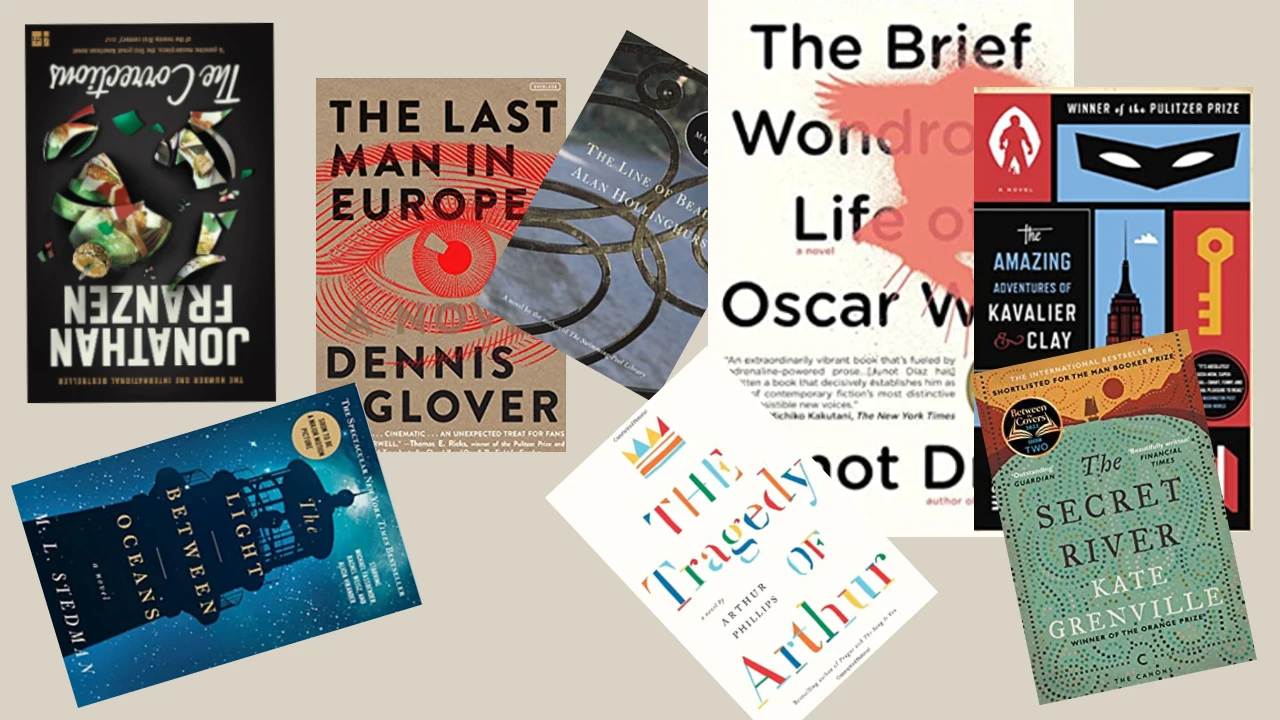
| 2004 | The Line of Beauty | Alan Hollinghurst |
| 2003 | Vernon God Little | DBC Pierre |
| 2002 | Life of Pi | Yann Martel |
| 2001 | True History of the Kelly Gang | Peter Carey |
| 2000 | The Blind Assassin | Margaret Atwood |
| Year | Winner | Author |
|---|---|---|
| 1999 | Disgrace | J. M. Coetzee |
| 1998 | Amsterdam | Ian McEwan |
| 1997 | The God of Small Things | Arundhati Roy |
| 1996 | Last Orders | Graham Swift |
| 1995 | The Ghost Road | Pat Barker |
| 1994 | How Late It Was, How Late | James Kelman |
| 1993 | Paddy Clarke Ha Ha Ha | Roddy Doyle |
| 1992 | The English Patient (shared) | Michael Ondaatje |
| 1992 | Sacred Hunger (shared) | Barry Unsworth |
| 1991 | The Famished Road | Ben Okri |
| 1990 | Possession | A. S. Byatt |
| Year | Winner | Author |
|---|---|---|
| 1989 | The Remains of the Day | Kazuo Ishiguro |
| 1988 | Oscar and Lucinda | Peter Carey |
| 1987 | Moon Tiger | Penelope Lively |
| 1986 | The Old Devils | Kingsley Amis |
| 1985 | The Bone People | Keri Hulme |
| 1984 | Hotel du Lac | Anita Brookner |
| 1983 | Life & Times of Michael K | J. M. Coetzee |
| 1982 | Schindler’s Ark | Thomas Keneally |
| 1981 | Midnight’s Children | Salman Rushdie |
| 1980 | Rites of Passage | William Golding |
| Year | Winner | Author |
|---|---|---|
| 1979 | Offshore | Penelope Fitzgerald |
| 1978 | The Sea, the Sea | Iris Murdoch |
| 1977 | Staying On | Paul Scott |
| 1976 | Saville | David Storey |
| 1975 | Heat and Dust | Ruth Prawer Jhabvala |
| 1974 | The Conservationist (shared) | Nadine Gordimer |
| 1974 | Holiday (shared) | Stanley Middleton |
| 1973 | The Siege of Krishnapur | J. G. Farrell |
| 1972 | G. | John Berger |
| 1971 | In a Free State | V. S. Naipaul |
| 1970 | The Elected Member | Bernice Rubens |
| Year | Winner | Author |
|---|---|---|
| 1969 | Something to Answer For | P. H. Newby |
A footnote for the completist: a quirk of the calendar in 1971 left the novels of 1970 in limbo, and in 2010 a public vote awarded a “Lost Man Booker Prize” to J. G. Farrell’s Troubles to close the gap. Farrell remains the only writer honored twice in spirit, having also won outright in 1973.
More than half a century of winners is too much to face at once, and not every laureate has worn equally well. A handful, though, are among the essential novels of their age, and together they show the range of a prize that has always looked well beyond England for the best writing in English.
The natural place to begin is Salman Rushdie’s Midnight’s Children, twice voted the best winner in the prize’s history and the novel that bound the fate of one child to the birth of independent India in a torrent of new, exuberant English. From there, cross to the opposite temperament in Kazuo Ishiguro’s The Remains of the Day, a masterpiece of restraint in which an English butler’s perfect composure slowly reveals the wreckage of a wasted life. Hilary Mantel’s Wolf Hall, the first of her two winners, reinvented the historical novel by lodging the reader inside the watchful mind of Thomas Cromwell.
The prize has always been at its best when it reaches beyond London. Ben Okri’s The Famished Road brought Yoruba cosmology and a spirit-child narrator into the English novel, and Arundhati Roy’s The God of Small Things made a Keralan childhood shimmer with grief and forbidden love in a debut of astonishing assurance. Marlon James’s A Brief History of Seven Killings turns the attempted assassination of Bob Marley into a polyphonic epic of Jamaica, and Anna Burns’s Milkman renders the claustrophobia of the Troubles through a young woman who names no one, in one of the most formally daring books the prize has crowned. For a gentler entry, Yann Martel’s Life of Pi remains the most beloved of modern winners, a castaway fable that has sent millions of readers to the prize for the first time. For the fiction the Booker cannot reach, the novel not written in English, our companion guide to award-winning books turns to the International Booker and the wider world of world literature.
The Booker has never been shy of controversy, and its quarrels are part of what keeps it alive. The deepest concerns the 2014 rule change that made American writers eligible, which many feared would let the vast machinery of American publishing crowd out the very Commonwealth voices the prize had done so much to raise; the debate has not cooled. The judges themselves have sometimes rebelled against their own rules, most famously in 2019, when they defied a clear instruction against a tie and split the award between Margaret Atwood and Bernardine Evaristo, and in 1974 and 1992 when the prize was likewise shared. And as with every award, the omissions provoke as much heat as the choices, since novels now regarded as untouchable, from writers passed over in their prime, sit only on the shortlists. The honest reader will treat the Booker as what it is, not a verdict of posterity but a vivid annual argument about the state of the novel, conducted louder and in better company than anywhere else.
Return, at the end, to that November evening and the strange civic ritual it represents: an entire culture pausing, for one night, to care which novel was best. The choice is always arguable, and the list read whole is a record of disagreements as much as triumphs. Yet the Booker’s real gift is not the rightness of any single verdict but the attention it commands, the yearly insistence that the serious novel still matters enough to argue about in public. The winners on this list are less a set of final judgments than an invitation to join the argument, and the best of them will outlast every prize that named them.