Newsletter Subscribe
Enter your email address below and subscribe to our newsletter


This content may contain affiliate links. When you buy through these links, we may earn an affiliate commission.
Once a year, in the first week of May, a committee in New York does something no reader would dare attempt: it names the finest work of American fiction of the year, and prints a single title where a whole literature might go. The presumption is enormous, and the record it has produced, running unbroken in spirit from 1918 to the present, is one of the most revealing documents American letters possesses. Read straight through, the list of Pulitzer Prize for Fiction winners is less a hall of fame than a slow-motion argument about what an American novel is for.
This page holds that argument in full. Below you will find every winner from Ernest Poole in 1918 to Daniel Kraus in 2026, the years the board declined to choose at all, and, for the reader who wants a way in rather than a catalogue, a shorter path through the novels that have best survived their moment of triumph. The prize has crowned the immortal and the forgotten in almost equal measure, and part of the pleasure of the whole list is learning to tell which is which. For the wider context, this is one entry in our guide to the most prestigious literary awards in the world.
The award was among the original Pulitzers, established from the bequest of the newspaperman Joseph Pulitzer and administered by Columbia University. From 1918 to 1947 it was given as the Pulitzer Prize for the Novel; since 1948 it has honored fiction more broadly, which is why short story collections by Hemingway’s heirs and interrelated tales like James Michener’s sit comfortably beside the big social novels. The stated criterion has a telling vagueness: distinguished fiction by an American author, preferably dealing with American life. That word “preferably” has done a great deal of quiet work, nudging a century of judges toward books that take the measure of the country itself.
The mechanism matters, because it explains the controversies. A jury of three reads through the year and forwards a small set of finalists, but the final choice rests with the Pulitzer Board, which is free to overrule the jury or to award nothing at all. This division of power is the source of the prize’s most famous storms, and it is also what keeps the award from settling into mere consensus. The board’s verdict can remake a writer’s life overnight; it can also, in a handful of bitter years, refuse to render a verdict entirely.
The 2026 Pulitzer Prize for Fiction went to Daniel Kraus for Angel Down, a novel of the First World War in which a company of soldiers discovers a fallen angel among the dead of No Man’s Land. Its formal daring is the point: the whole book is written as a single, unbroken sentence, a breathless syntax that refuses the reader any safe place to rest, which is precisely the condition of the men it describes.
It follows two of the more decorated novels of the decade. The 2025 prize crowned Percival Everett’s James, a retelling of Huckleberry Finn from the perspective of the enslaved Jim, and the 2024 award went to Jayne Anne Phillips for Night Watch, set in a West Virginia asylum in the aftermath of the Civil War. This section is updated each May as the new winner is announced.
The record below is given most recent first, grouped by decade. Entries through 1947 were awarded under the prize’s earlier name, the Pulitzer Prize for the Novel. The years marked “not awarded” are not oversights; in each case the board considered the field and chose to withhold the prize.
| Year | Winner | Author |
|---|---|---|
| 2026 | Angel Down | Daniel Kraus |
| 2025 | James | Percival Everett |
| 2024 | Night Watch | Jayne Anne Phillips |
| 2023 | Demon Copperhead | Barbara Kingsolver |
| 2022 | The Netanyahus | Joshua Cohen |
| 2021 | The Night Watchman | Louise Erdrich |
| 2020 | The Nickel Boys | Colson Whitehead |
| Year | Winner | Author |
|---|---|---|
| 2019 | The Overstory | Richard Powers |
| 2018 | Less | Andrew Sean Greer |
| 2017 | The Underground Railroad | Colson Whitehead |
| 2016 | The Sympathizer | Viet Thanh Nguyen |
| 2015 | All the Light We Cannot See | Anthony Doerr |
| 2014 | The Goldfinch | Donna Tartt |
| 2013 | The Orphan Master’s Son | Adam Johnson |
| 2012 | Not awarded | — |
| 2011 | A Visit from the Goon Squad | Jennifer Egan |
| 2010 | Tinkers | Paul Harding |
| Year | Winner | Author |
|---|---|---|
| 2009 | Olive Kitteridge | Elizabeth Strout |
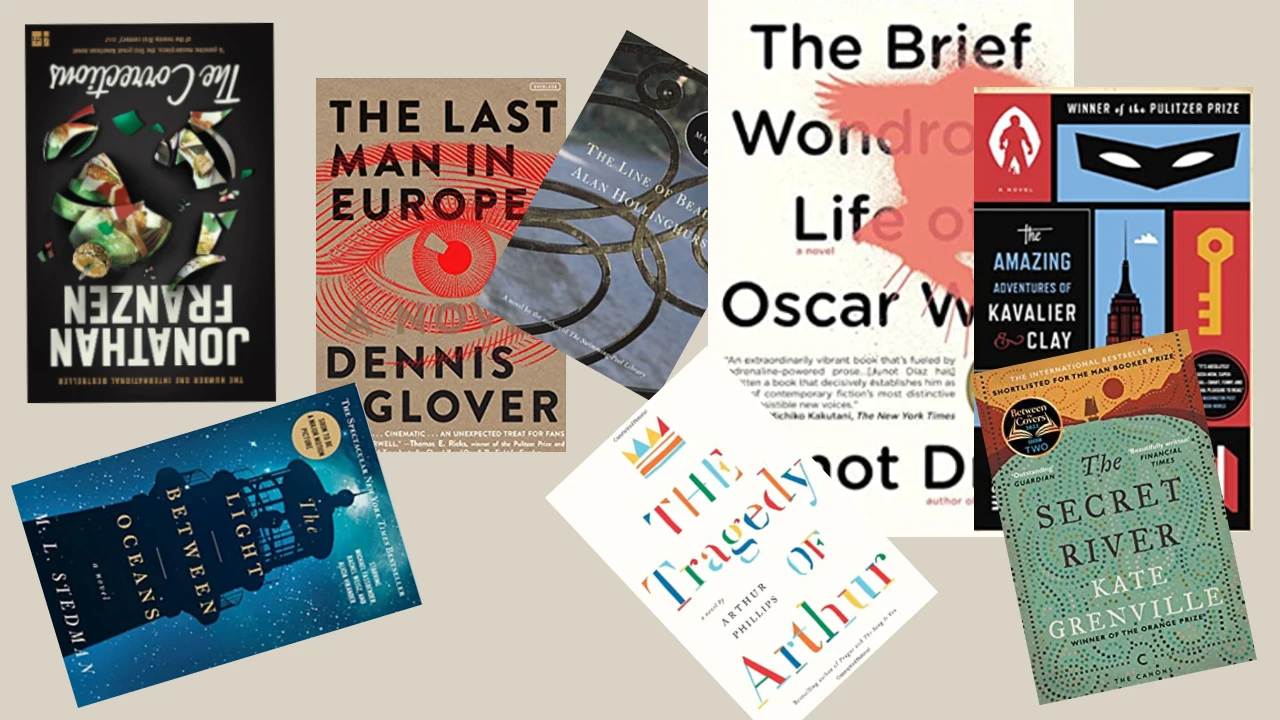
| 2008 | The Brief Wondrous Life of Oscar Wao | Junot Díaz |
| 2007 | The Road | Cormac McCarthy |
| 2006 | March | Geraldine Brooks |
| 2005 | Gilead | Marilynne Robinson |
| 2004 | The Known World | Edward P. Jones |
| 2003 | Middlesex | Jeffrey Eugenides |
| 2002 | Empire Falls | Richard Russo |
| 2001 | The Amazing Adventures of Kavalier & Clay | Michael Chabon |
| 2000 | Interpreter of Maladies | Jhumpa Lahiri |
| Year | Winner | Author |
|---|---|---|
| 1999 | The Hours | Michael Cunningham |
| 1998 | American Pastoral | Philip Roth |
| 1997 | Martin Dressler: The Tale of an American Dreamer | Steven Millhauser |
| 1996 | Independence Day | Richard Ford |
| 1995 | The Stone Diaries | Carol Shields |
| 1994 | The Shipping News | E. Annie Proulx |
| 1993 | A Good Scent from a Strange Mountain | Robert Olen Butler |
| 1992 | A Thousand Acres | Jane Smiley |
| 1991 | Rabbit at Rest | John Updike |
| 1990 | The Mambo Kings Play Songs of Love | Oscar Hijuelos |
| Year | Winner | Author |
|---|---|---|
| 1989 | Breathing Lessons | Anne Tyler |
| 1988 | Beloved | Toni Morrison |
| 1987 | A Summons to Memphis | Peter Taylor |
| 1986 | Lonesome Dove | Larry McMurtry |
| 1985 | Foreign Affairs | Alison Lurie |
| 1984 | Ironweed | William Kennedy |
| 1983 | The Color Purple | Alice Walker |
| 1982 | Rabbit Is Rich | John Updike |
| 1981 | A Confederacy of Dunces | John Kennedy Toole |
| 1980 | The Executioner’s Song | Norman Mailer |
| Year | Winner | Author |
|---|---|---|
| 1979 | The Stories of John Cheever | John Cheever |
| 1978 | Elbow Room | James Alan McPherson |
| 1977 | Not awarded | — |
| 1976 | Humboldt’s Gift | Saul Bellow |
| 1975 | The Killer Angels | Michael Shaara |
| 1974 | Not awarded | — |
| 1973 | The Optimist’s Daughter | Eudora Welty |
| 1972 | Angle of Repose | Wallace Stegner |
| 1971 | Not awarded | — |
| 1970 | Collected Stories | Jean Stafford |
| Year | Winner | Author |
|---|---|---|
| 1969 | House Made of Dawn | N. Scott Momaday |
| 1968 | The Confessions of Nat Turner | William Styron |
| 1967 | The Fixer | Bernard Malamud |
| 1966 | The Collected Stories | Katherine Anne Porter |
| 1965 | The Keepers of the House | Shirley Ann Grau |
| 1964 | Not awarded | — |
| 1963 | The Reivers | William Faulkner |
| 1962 | The Edge of Sadness | Edwin O’Connor |
| 1961 | To Kill a Mockingbird | Harper Lee |
| 1960 | Advise and Consent | Allen Drury |
| Year | Winner | Author |
|---|---|---|
| 1959 | The Travels of Jaimie McPheeters | Robert Lewis Taylor |
| 1958 | A Death in the Family | James Agee |
| 1957 | Not awarded | — |
| 1956 | Andersonville | MacKinlay Kantor |
| 1955 | A Fable | William Faulkner |
| 1954 | Not awarded | — |
| 1953 | The Old Man and the Sea | Ernest Hemingway |
| 1952 | The Caine Mutiny | Herman Wouk |
| 1951 | The Town | Conrad Richter |
| 1950 | The Way West | A. B. Guthrie |
| Year | Winner | Author |
|---|---|---|
| 1949 | Guard of Honor | James Gould Cozzens |
| 1948 | Tales of the South Pacific | James A. Michener |
| 1947 | All the King’s Men | Robert Penn Warren |
| 1946 | Not awarded | — |
| 1945 | A Bell for Adano | John Hersey |
| 1944 | Journey in the Dark | Martin Flavin |
| 1943 | Dragon’s Teeth | Upton Sinclair |
| 1942 | In This Our Life | Ellen Glasgow |
| 1941 | Not awarded | — |
| 1940 | The Grapes of Wrath | John Steinbeck |
| Year | Winner | Author |
|---|---|---|
| 1939 | The Yearling | Marjorie Kinnan Rawlings |
| 1938 | The Late George Apley | John Phillips Marquand |
| 1937 | Gone with the Wind | Margaret Mitchell |
| 1936 | Honey in the Horn | Harold L. Davis |
| 1935 | Now in November | Josephine Winslow Johnson |
| 1934 | Lamb in His Bosom | Caroline Miller |
| 1933 | The Store | T. S. Stribling |
| 1932 | The Good Earth | Pearl S. Buck |
| 1931 | Years of Grace | Margaret Ayer Barnes |
| 1930 | Laughing Boy | Oliver La Farge |
| Year | Winner | Author |
|---|---|---|
| 1929 | Scarlet Sister Mary | Julia Peterkin |
| 1928 | The Bridge of San Luis Rey | Thornton Wilder |
| 1927 | Early Autumn | Louis Bromfield |
| 1926 | Arrowsmith | Sinclair Lewis |
| 1925 | So Big | Edna Ferber |
| 1924 | The Able McLaughlins | Margaret Wilson |
| 1923 | One of Ours | Willa Cather |
| 1922 | Alice Adams | Booth Tarkington |
| 1921 | The Age of Innocence | Edith Wharton |
| 1920 | Not awarded | — |
| Year | Winner | Author |
|---|---|---|
| 1919 | The Magnificent Ambersons | Booth Tarkington |
| 1918 | His Family | Ernest Poole |
A century of winners is a daunting thing to face at once, and the honest truth is that some of these books have aged into curiosities while others have only deepened. For a reader beginning here, a handful of the winners reward attention out of all proportion to their age, and each opens onto a different corner of the American century.
Begin, if the manners of old New York can hold you, with Edith Wharton’s The Age of Innocence, the first novel by a woman to take the prize and still the most surgical account of how a society enforces its rules by making them invisible. From there the ground shifts to the dust of the Depression in John Steinbeck’s The Grapes of Wrath, a book whose anger has not cooled in eighty years and whose final image remains one of the most audacious in American fiction. Harper Lee’s To Kill a Mockingbird needs no introduction, yet it repays a second adult reading, when its child’s-eye clarity reveals itself as something far more troubled than the schoolroom version admits.
The prize’s later decades hold its bravest choices. Toni Morrison’s Beloved is the summit, a novel that treats slavery not as history but as a haunting the living cannot put down, and it is the rare winner that has grown larger, not smaller, with time. For the reader who wants scope, Larry McMurtry’s Lonesome Dove smuggles a profound meditation on friendship and mortality inside the most propulsive Western ever written. Cormac McCarthy’s The Road strips the American novel to its bones, a father and son on a dead continent, and finds at the bottom of that austerity an almost unbearable tenderness. And for the way the prize speaks to the present, read Colson Whitehead’s The Underground Railroad beside Percival Everett’s James: two winners, a decade apart, that reach back into the literature of bondage and rebuild it from the inside.
No account of this award is complete without its refusals, because the board’s willingness to give nothing at all is exactly what makes its assent mean something. In 1941 the jury and the board both favored Hemingway’s For Whom the Bell Tolls, until the president of Columbia found the book offensive and the year passed with no fiction prize awarded. In 2012, more notoriously, the jury forwarded three finalists and the board could agree on none of them, leaving readers and publishers to argue for a decade about what the silence meant. Set against these are the redemptions the prize occasionally manages, none more moving than the 1981 award to John Kennedy Toole for A Confederacy of Dunces, given more than a decade after the author’s death, a laurel laid on a grave. The honest reader will find the record neither infallible nor corrupt, but human, which is the most that can be asked of any jury tasked with the impossible.
Return, at the last, to the presumption with which this began: the idea that a country can choose, once a year, the single book that best speaks for it. Taken one at a time, the choices are arguable, and half the fun of the list is the arguing. Taken together, they trace something no individual novel could, the long, restless self-examination of a nation trying to read itself, decade by decade, in the mirror of its own fiction. The prize does not tell us which books are great; time does that, slowly and without ceremony. What the Pulitzer gives us is the record of what America believed about itself in the moment of choosing, and that, for the attentive reader, is its own kind of literature.