
Newsletter Subscribe
Enter your email address below and subscribe to our newsletter


This content may contain affiliate links. When you buy through these links, we may earn an affiliate commission.
In February 1884, while the miners of Anzin in northern France were on strike, Émile Zola put on a miner’s clothes and went down a pit at Denain, some six hundred metres below the ground. He filled notebooks with what he saw there: the cramped seams, the heat, the horses that lived their whole lives underground, the families who lived in rows of identical brick houses. The novel he made from them, Germinal, appeared the following year. When Zola was buried in Paris in 1902, a delegation of miners from Denain walked behind the coffin chanting the title of the book, as if it were a name they had been waiting to be called.
That moment says something about what a great novel of work can be. It is not a pamphlet, and it is not a postcard of picturesque poverty; it is a book in which working people can recognize their own lives, told with enough truth that they claim it as theirs. The United States has kept Labor Day, the first Monday in September, as a federal holiday since 1894, and the season is a good time to read such books, though they belong to every season. The fifteen novels below come from France, America, Britain, Senegal, Japan, China, India, Brazil, and Germany, and they range from the coal pits of the 1880s to the fish canneries of Brittany in our own century. Each of them asks the same question in a different place: what work does to a human life, and what a human life can make of work in return.
There are, broadly, two kinds. Some are written about workers by writers from outside their world: Zola was a journalist’s son, Upton Sinclair a socialist reporter, Steinbeck a Stanford dropout who spent months among the migrant camps. Others are written from inside by people who did the work: Robert Tressell was a house painter, Thomas Bell a steelworker, Alan Sillitoe a factory hand at fourteen, and Joseph Ponthus wrote his book while still working on the line. The first kind tends to see the system; the second tends to see the day, the ache, the joke, and the clock. The greatest books on this list manage both.
What they share is a refusal of two easy temptations. One is pity, the habit of turning workers into victims to be wept over by readers who will never share their lives. The other is propaganda, the habit of turning them into heroes of a story whose ending has already been decided. The best working-class novels give their people inner lives as complicated as anyone’s, and they let the facts of labour, the hours, the wages, the injuries, and the small dignities, carry the argument.
Étienne Lantier, an unemployed machinist, arrives at the mining village of Montsou on a freezing night, takes a job in the pit called Le Voreux, and within a year has led its miners into a strike that ends in starvation, gunfire, and the flooding of the mine. Germinal (1885), the thirteenth novel in Zola’s Rougon-Macquart cycle, is the founding epic of industrial labour, and its central idea lies in its title, the name of the spring month in the French revolutionary calendar. The strike fails; the miners go back down; and yet Zola insists that something has been planted that cannot be dug up. His mine is a living monster that devours men, but the people it devours are never merely victims: they drink, make love, betray one another, and argue about politics with a vitality that no other novelist of the period gave to the poor. In Havelock Ellis’s old translation, the final pages see beneath the fields “a black avenging army, germinating slowly in the furrows.” Roger Pearson’s Penguin translation (2004) and Peter Collier’s for Oxford (1993) are the modern versions to read.
Jurgis Rudkus, a strong young Lithuanian immigrant, arrives in Chicago with his family full of hope and finds work in the stockyards of Packingtown, where the meatpacking houses, as one of the novel’s characters puts it, “use everything about the hog except the squeal.” Within a few years the family has been destroyed: by injury, debt, disease, and a system designed to use them up as thoroughly as the hogs. Sinclair’s novel (1906) caused a national sensation, but not the one he intended. Readers were horrified less by what happened to the workers than by what went into their sausages, and within months Congress passed the Meat Inspection Act and the Pure Food and Drug Act. Sinclair’s verdict on his own success, in Cosmopolitan that October, has become famous: “I aimed at the public’s heart,” he wrote, and by accident hit it in the stomach. That remark contains the book’s lasting lesson about how hard it is to make comfortable readers care about the lives of the people who feed them. The final chapters turn into socialist speeches and lose much of their power as fiction, but the first two-thirds remain one of the most harrowing accounts of industrial labour ever written.
Thomas Bell grew up in Braddock, Pennsylvania, the son of Slovak immigrants, and worked in its steel mills before he became a writer. Out of This Furnace (1941) is the story of three generations of a Slovak family in the Monongahela Valley: George Kracha, who arrives in the 1880s; his daughter Mary and her husband Mike Dobrejcak, a steelworker; and their son John, known as Dobie, who comes of age in the 1930s and joins the drive to organize the mills. The idea that gives the book its shape is that each generation pays for the next: Kracha’s dreams of prosperity collapse, Mike works twelve-hour shifts until the furnace kills him, and only Dobie, American-born, can demand what his grandfather never dared to ask. Bell writes without speeches and without sentimentality, and the result is a quiet, powerful history of how immigrant workers became Americans by fighting for the right to organize. It was nearly forgotten until the University of Pittsburgh Press reissued it in 1976, and it is now the classic novel of American steel.
A crew of house painters in a seaside town called Mugsborough, closely modelled on Hastings, spends a year renovating a house for a rich man, and the book records their work, their bosses, their poverty, and their arguments with Frank Owen, a skilled painter and socialist who cannot understand why his workmates defend the system that exploits them. The title is the joke at the book’s heart: the workers are “philanthropists” because they give the profit of their labour away to their employers, and they do it gladly, voting for the parties of their masters. In the famous chapter “The Great Money Trick,” Owen uses slices of bread to show his mates how the system works, and he states his thesis plainly: “Money is the real cause of poverty.” Tressell, whose real name was Robert Noonan, died of tuberculosis in Liverpool in 1911 and was buried in a pauper’s grave; his daughter Kathleen saved the manuscript, which was published in a heavily cut version in 1914 and in full only in 1955. It has been the bible of the British labour movement for a century, and its anger, comedy, and detailed knowledge of the trade keep it alive.
From October 1947 to March 1948, the African workers of the Dakar–Niger railway, which ran from the Senegalese coast into what is now Mali, struck for the same pay and rights as their French colleagues. Sembène’s novel (1960), translated by Francis Price in 1962, tells the story of that strike, and its central idea is that the strike changed not only the relations between workers and their colonial masters but the relations between men and women. As the strike drags on and the men grow weary, it is the women who keep it alive, finding food and water, facing down the police, and finally marching from Thiès to Dakar to make their voices heard. The novel has no single hero: its union leader is mostly absent, and its protagonist is the community itself, dozens of characters whose lives the strike transforms. Sembène, who had worked as a docker in Marseille and would become the father of African cinema, wrote it as a monument to a struggle that colonial history had chosen to forget. It is one of the essential novels in our guide to modern African literature.
A factory ship sails into the cold waters off Kamchatka, carrying hundreds of seasonal workers, many of them boys, who will catch crabs and can them on board under conditions close to slavery. Kanikōsen (1929) was written by a young bank clerk and communist sympathizer, and it is one of the strangest and most powerful novels of its decade: a book without a hero, in which the workers appear as a collective, suffering and finally rebelling together against a brutal supervisor. When their first strike is crushed by sailors from an imperial destroyer, the workers learn that the state they trusted belongs to their employers, and they prepare to strike again. Kobayashi paid for the book with his life. In February 1933 he was arrested by the Tokkō, the special higher police, and tortured to death at a Tokyo police station; the authorities said he had died of heart failure. In 2008, amid a new age of temporary and precarious work, the novel became a bestseller in Japan once more, selling around half a million copies. Željko Cipris’s translation (2013) is the one to read, and it belongs beside the novels in our guide to the best Japanese novels.
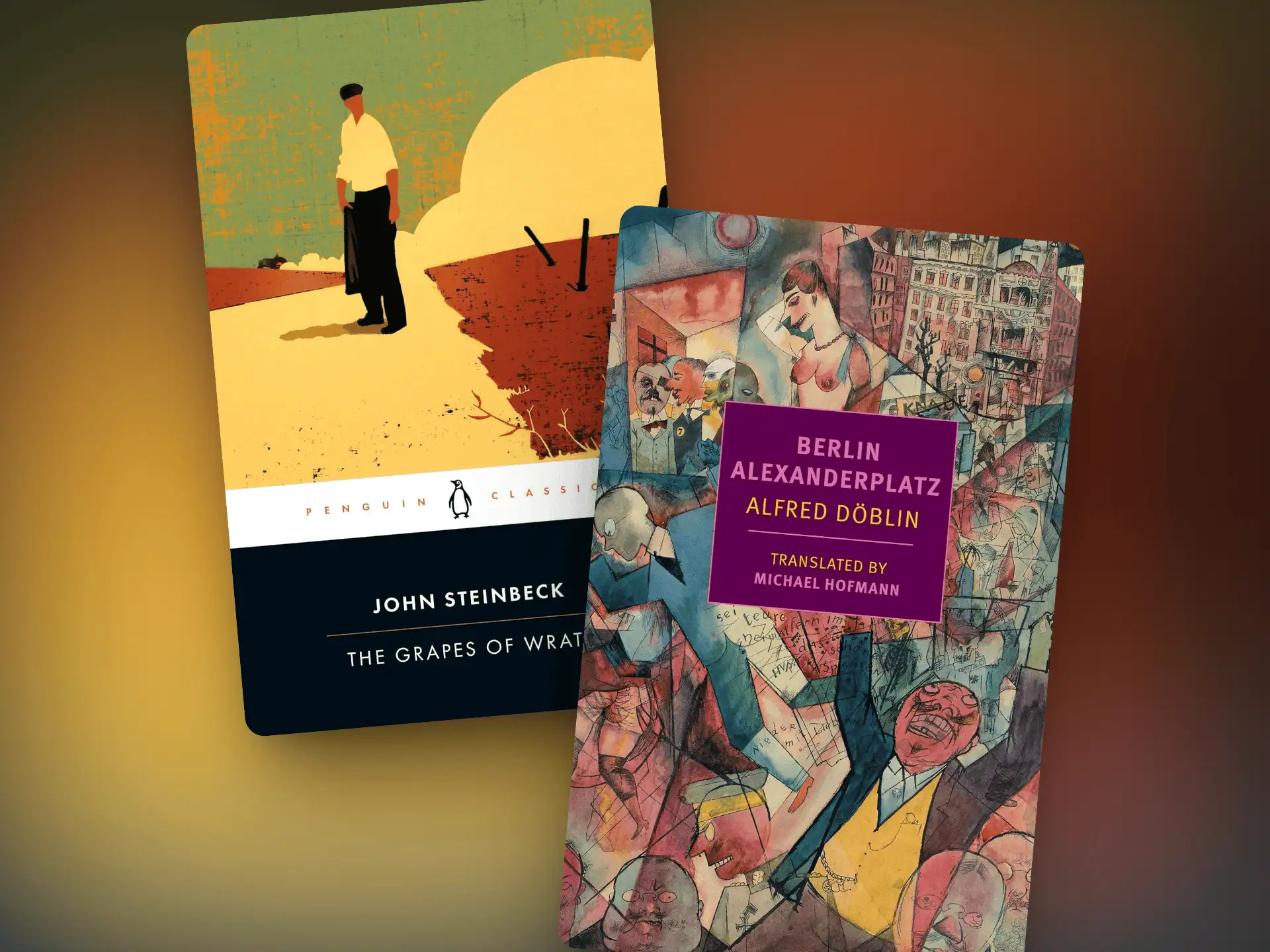
The Joad family, driven off their Oklahoma farm by drought, debt, and the tractors of the banks, load their belongings onto a truck and drive west along Route 66 to California, where they have been promised work, and find instead a land of migrant camps, starvation wages, and hostility. The Grapes of Wrath (1939) won the Pulitzer Prize in 1940, and its idea is that the family, the oldest human unit, is being dissolved by economic forces, and that a larger family must take its place: Tom Joad’s journey is from loyalty to his own people to loyalty to all the dispossessed. Steinbeck alternates the Joads’ story with short chapters about the great migration as a whole, and in one of them he describes the anger of the dispossessed: “in the eyes of the hungry there is a growing wrath.” The book was so threatening to California’s farm owners that the supervisors of Kern County banned it from schools and libraries in 1939, and a copy was publicly burned in Bakersfield. Its final scene, which many readers find shocking, is the purest statement of its belief that human beings can still offer one another life when everything else has been taken.
A family of drovers, Fabiano, his wife Sinhá Vitória, their two sons, and their dog Baleia, crosses the drought-stricken sertão of northeastern Brazil in search of work and water, settles for a time on a ranch, and moves on again when the drought returns. Vidas secas (1938), translated by Ralph Edward Dimmick as Barren Lives (1965), is one of the masterpieces of Brazilian literature, and its idea is that poverty is not only a matter of food and money but of language. Fabiano can barely speak; he cannot argue with the boss who cheats him or the soldier who beats him, and his silence is the deepest form of his dispossession. Ramos writes in short, hard, bare chapters that can almost be read separately, and the chapter in which the dog Baleia dies, told partly from her point of view, is among the most moving pages in Latin American fiction. Ramos was imprisoned without trial by the Vargas regime in 1936 and 1937, and the book’s anger at the powerful is all the more terrible for being so quiet.
A single day in the life of Bakha, an eighteen-year-old latrine cleaner in a north Indian cantonment town, from the moment he is woken at dawn to clean the public latrines to the evening when he hears three possible answers to his condition. Untouchable (1935) was rejected by a long string of publishers before E. M. Forster wrote a preface for it, and Anand revised it at Gandhi’s ashram, where Gandhi read and approved it. Its idea is that caste is a system of labour: Bakha is untouchable because of the work he does, and the work is his because he is untouchable, a closed circle that the novel shows from inside. The day’s events are small, an accidental touch, an insult, a slap, a kind word from a stranger, but each reveals the weight of a whole society’s contempt. At the end Bakha hears a Christian missionary, a speech by Gandhi, and a poet who suggests that a machine, the flush toilet, will free him, and the book leaves the choice open. It was one of the first Indian novels in English to make an untouchable its hero, and it remains the most searching.
Franz Biberkopf, a former cement worker and furniture mover, is released from Tegel prison after serving four years for killing his girlfriend, and resolves to go straight. Berlin has other plans. Berlin Alexanderplatz (1929), newly translated by Michael Hofmann (2018), follows him through the city of the late Weimar Republic as he sells shoelaces and newspapers, falls in with a gang of thieves, loses an arm, and slides into the underworld. Strictly it is a novel of the edges of the working class rather than its centre, the world of casual labour and no labour at all, and its idea is that the modern city is itself a machine, so vast and noisy that a decent, slow man can be crushed by it without anyone noticing. Döblin built the novel as a collage of advertisements, newspaper reports, songs, statistics, and biblical parables, so that the city speaks through every page. Fassbinder’s 1980 television adaptation is one of the great works of German cinema, and the novel remains the essential portrait of the city between the wars.
Xiangzi, a young peasant who has come to Beijing, pulls a rickshaw for hire and dreams of owning one himself; he works and saves for three years, buys his rickshaw, and loses it within months to soldiers who seize him and his vehicle. He saves again, and his savings are stolen; he marries, and the marriage ruins him. Lao She’s novel, serialized from 1937, is the great Chinese novel of urban labour, and its idea is that in a society without justice, the virtues of hard work and thrift become traps: Xiangzi’s honesty and strength are exactly what the city exploits, and his fall is the price of believing in them. When the novel was first translated into English in 1945, the translator invented a happy ending, and the book became an American bestseller under a false resolution. Howard Goldblatt’s translation (2010) restored Lao She’s original, which is bleaker and truer. Lao She himself was beaten by Red Guards in August 1966 and was found drowned in a Beijing lake the next day.
Lutie Johnson, a young Black woman who has worked as a domestic for a rich white family in Connecticut, moves with her eight-year-old son into a cramped apartment on 116th Street in Harlem and resolves to work her way out. The novel (1946) follows her through jobs, night classes, a singing career that is offered and then withheld, and the men who want something from her in exchange for every opportunity. Its idea is that the street itself, its poverty, racism, and sexual danger, is a force as relentless as the mine in Germinal, and that for a woman like Lutie, hard work and good character are not enough to escape it. Petry, a pharmacist and journalist before she was a novelist, won a literary fellowship for the manuscript, and The Street became the first novel by an African American woman to sell more than a million copies. It is still too little known outside the United States, and it is one of the most powerful novels of American city life.
Arthur Seaton, twenty-one, works a lathe at a Nottingham bicycle factory all week and spends his weekends drinking, fighting, and sleeping with the wives of other men. Sillitoe’s novel (1958), written by a man who had gone into the Raleigh factory at fourteen, was a sensation in its day because it showed a young working man who was neither a victim nor a hero but a rebel without a programme, contemptuous of his bosses, his union, the government, and anyone who tries to tell him how to live. Its idea is that the postwar welfare state has given workers like Arthur security without meaning: he earns good money for work that bores him, and his rebellion is all the freedom he has left. The 1960 film, with Albert Finney, made Arthur an icon, but the novel is richer and sadder. It is the founding book of the British working-class novel of the 1950s and still its best.
Joseph Ponthus, a literature graduate and social worker, followed his wife to Brittany, could not find work in his field, and took temporary jobs on the production lines of a fish cannery and an abattoir. On the Line: Notes from a Factory (2019), translated by Stephanie Smee (2021), is the book he made from it, written in short lines without punctuation, like a long poem whose rhythm is the rhythm of the line itself. Its idea is that factory work does not only exhaust the body but colonizes the mind: Ponthus’s thoughts, even off-shift, move to the beat of the machines, and he holds on to his sanity by reciting the poems and songs he loves while gutting fish and hauling carcasses. The book is funny, angry, tender, and heartbreakingly alert to the small solidarities of the shop floor. It won a string of French prizes, and Ponthus died in 2021 at forty-two, two years after it appeared. It is the finest book about industrial work written in this century, and a reminder that the factory has not disappeared, only moved out of sight. For more recent French fiction, see our guide to contemporary French novels.
Keiko Furukura, thirty-six, has worked for eighteen years at the same convenience store in Tokyo, and she is happy there: the store’s manuals tell her how to speak, how to smile, and how to be a normal person, which she has never known how to be on her own. Her family and friends want her to find a proper career or a husband, and the novel follows her attempt to meet their expectations. Murata’s short novel (2016), which won the Akutagawa Prize and was translated by Ginny Tapley Takemori (2018), turns the working-class novel inside out. Its idea is that work can be a refuge from society as much as a prison within it: Keiko does not want to escape the store, and her strangeness exposes the pressure to conform that rules every other life in the book. It is funny and unsettling, and it belongs to a new kind of novel about work, in which the job is not the problem but the only solution on offer. It stands beside the other books in our guide to the best Japanese novels.
The novels above can be read in any order, but some paths suit particular readers:
Zola ended Germinal with an image of seeds sprouting under the spring soil, and the miners who walked behind his coffin understood the promise in it: that the labour of the poor was not only suffering but the root of something that would one day break the surface. More than a century later, the image still holds, though not in the way Zola imagined. The world’s pits and mills have changed; the work has moved into canneries, warehouses, call centres, and convenience stores, and much of it has become less visible, scattered, temporary, and solitary. The books that tell its story have changed with it, from the collective strikes of Sembène and Kobayashi to the solitary voices of Ponthus and Murata.
What has not changed is the question these novels ask of every reader who has never done such work and every reader who has. Who makes the things we use, the food we eat, the cities we live in, and what does the making cost them? The great novels of work refuse to let that question become abstract. They give it a face, a family, a body that aches at the end of a shift, and a voice that is sometimes angry, sometimes funny, and almost always worth hearing. The seed in the furrow is not a promise of victory. It is the stubborn, recurring fact of human beings who, even under the worst conditions, insist on being more than their labour.